From the study of texts to the study of real-time experienced Magick
For a long time, scholars interested in magic, esotericism and occult traditions concentrated mainly on texts. This was understandable, because manuscripts, books, ritual instructions and doctrinal systems are what history leaves behind most reliably. They allow us to reconstruct how ideas moved through time, how one author influenced another, how magical systems were organised and how concepts such as spirits, astral bodies, divine names, correspondences and hidden forces changed from one period to another.
That scholarship has taught us an enormous amount, but it also leaves one rather obvious question unanswered. Magic is not merely something that people write about or believe in. It is something that people do.
A ritual text may tell someone to visualise a figure, repeat a divine name, regulate the breath, stare at a sigil, fast, pray at a particular hour, construct an inner temple or address an invisible intelligence. Reading that instruction tells us what the practitioner was supposed to do, but it does not tell us what happened when somebody actually followed the instruction. Did the image remain vague or did it become unusually vivid? Did the practitioner feel warmth, trembling or pressure somewhere in the body? Did the surrounding space seem to change? Did a figure appear? Did that figure continue to feel self-generated, or did it begin to behave in a way that seemed independent of the practitioner’s intention? Perhaps nothing happened at all.
Questions of this kind belong to a relatively recent development in the academic study of esotericism, usually described as the praxeological turn.
What praxeology means
The word praxeology derives from the Greek word praxis, meaning action or practice. In this context it refers to a simple methodological shift. If we want to understand a tradition that consists partly of practices, we should study those practices as practices. We need to know what people were instructed to do, what they actually did, what happened while they were doing it, and, where possible, how repeated practice changed them.
Bernd-Christian Otto has developed this approach in considerable detail for the study of esoteric practices. He distinguishes between different types of source material. A ritual manual gives us a prescription, because it tells the practitioner what should be done. An outsider may leave a description of what practitioners were believed to be doing. A diary or autobiography may contain an experience report, in which somebody records what happened while performing the practice. In some circumstances a scholar may also perform the practice and document the experience systematically, something Otto calls scholar-practitionership.
These distinctions are more important than they may first appear. Suppose an old manual says that the practitioner should visualise a luminous figure and repeat a sacred name seven times. That does not demonstrate that anyone ever saw such a figure. A later theologian might condemn the ritual as demonic, but that tells us more about the theologian’s interpretation than about the experience of the practitioner. A practitioner’s diary might then say that after several repetitions the figure suddenly became brighter and seemed to turn its head.
We now have three quite different forms of evidence, and praxeology tries to keep them apart.
That is especially important in magic because magical traditions are often highly procedural. Their practitioners are instructed to train attention, construct images, manipulate symbols, regulate breathing, repeat sounds, evoke particular emotional states or maintain awareness under unusual conditions. Many systems also assume that these capacities improve through practice.
Imagine someone being instructed to visualise a red sphere for ten minutes every day. During the first week the image may disappear every few seconds. A month later the sphere may remain stable for much longer. After continued practice it may acquire depth, luminosity and texture. Eventually it may even begin to change in ways that the practitioner did not consciously intend.
At that point we already have an interesting psychological and phenomenological question, regardless of what we think about magic as a metaphysical system. Repeated training has apparently changed what the person is capable of experiencing.
What phenomenology adds
This brings us to another word that can sound much more difficult than the idea behind it: phenomenology.
At its most practical level, phenomenology asks what an experience was actually like as it occurred. It temporarily postpones the question of what caused the experience and concentrates on its structure.
Someone may say, for example, “There was a presence in the room.” A phenomenological inquiry would not immediately decide whether that presence was a spirit, an imaginative construction, a neurological event or something else. It would first ask what the person means by “presence.” Was something seen? Was a voice heard? Was there a bodily sensation? Did the person simply have an unusually strong feeling that somebody else was there? Did the presence seem to occupy a particular part of the room, or was it diffuse? Did it arrive suddenly or develop gradually? Was the experience accompanied by fear, awe, calmness or curiosity? Did the person still feel fully in control?
This kind of slowing down is important because ordinary experience is full of rapid interpretation. We hear a noise downstairs and almost immediately think that somebody is in the house. We feel something in our pocket and interpret it as the vibration of a phone. The interpretation may be correct, but it is not identical with the sensation that gave rise to it.
The same is true in esoteric practice. A practitioner may feel pressure on the chest and interpret it as subtle energy. Another may see a luminous human-like figure and call it an angel. A third may experience an unexpected inner voice and regard it as communication from an independent intelligence.
The interpretation matters, because it belongs to the person’s cultural and spiritual world, but for research purposes it is useful to distinguish between the experience and the meaning assigned to it.
What we mean by appraisal
Researchers often use the word appraisal for this second step.
An appraisal is simply the interpretation or evaluation of an experience. If someone sees a luminous figure and concludes that it was an angel, “angel” is the appraisal. If someone feels an intense vibration in the body and decides that kundalini has awakened, that is also an appraisal. If a ritual is followed the next day by an unexpected phone call and the practitioner concludes that the ritual worked, the conclusion that the event demonstrates magical efficacy is an appraisal.
This does not mean that the appraisal is wrong. It means that the appraisal and the experience should not be collapsed into one thing.
That distinction has become increasingly important in research on unusual or nonordinary experiences. Ann Taves and colleagues, for example, have developed approaches in which features of an experience are distinguished from the meanings subsequently attributed to them. Our own work develops the same principle specifically for practice-induced esoteric experience.
The meaning of agency
One of the most important dimensions in this kind of research is something psychologists and philosophers call agency.
Agency refers to the felt sense that I am doing this.
When I deliberately raise my hand, I normally experience myself as the agent of the movement. When I deliberately imagine a red sphere, I also know that I am producing the image. The experience belongs to me and feels under my control.
Yet agency is not always so simple.
Suppose a practitioner intentionally visualises a figure. At first every feature of the image is deliberately constructed. The practitioner chooses the colour of the clothing, the posture and the face. After several minutes, however, the figure turns around without the practitioner intending it. Perhaps it says something unexpected. Perhaps the practitioner asks a question and experiences an answer that did not feel consciously composed.
The experience has now shifted along the dimension of agency.
It began as:
I am making this happen.
It may then become:
I started it, but now it seems to be continuing by itself.
And sometimes the report becomes:
This is happening to me.
That transition is extraordinarily interesting because it occurs in several domains besides ritual magic. It can be found in prayer, dreams, automatic writing, active imagination, some forms of meditation, mediumistic practice and certain psychedelic states.
The important research question is therefore not initially whether the figure really became an independent being. The first question is how an experience that began as deliberately generated imagery came to be experienced as increasingly autonomous.
That is what we mean when we study agency.
From reports to events
This problem led us to another distinction that has become central in our own work.
An experience report is usually a story told after the event. It may be accurate, but it is already organised by memory and interpretation. Long rituals are particularly difficult because several different experiences may occur during the same session and later become compressed into a single narrative.
Someone might say:
“During the ritual I entered a visionary state.”
When examined more closely, however, that visionary state may have consisted of several successive events. First the breathing changed. Then the body began to vibrate. After that a coloured form appeared. The form became person-like. Attention narrowed. The figure began to seem autonomous. A voice was heard. Only afterwards did the practitioner decide that an entity had been encountered.
Calling the whole sequence “a vision” conceals much of what actually happened.
For this reason we use the experiential event as a basic unit of analysis. An event is simply a relatively distinguishable change in experience. It may last seconds or minutes. Its boundaries may be sharp or uncertain. The important point is that we try to identify where something changed rather than treating an entire ritual session as one undifferentiated altered state.
This is sometimes called event segmentation. Again, the term is more technical than the basic idea. It means dividing a long stream of experience into episodes that can be examined separately.
Why time matters
Time is particularly important because experiences develop.
A visual image may start faintly, become brighter, begin to move, become accompanied by bodily sensations and only later acquire a sense of presence. If we record only the final stage, we lose the process that produced it.
This is one area in which contemporary microphenomenology is useful. Microphenomenology attempts to reconstruct experience at a much finer temporal scale than ordinary recollection. Instead of asking someone generally what meditation or ritual is like, the interviewer returns repeatedly to a specific moment: what happened first, what changed next, where attention moved, what happened in the body, and when the interpretation arose.
The aim is not perfect access to consciousness. Memory remains fallible. It is simply better to work with a carefully reconstructed event than with a vague statement about what “usually happens.”
From one dimension to a configuration
In our forthcoming academic paper we introduce the Practice-Induced Esoteric Experience Reporting Protocol, abbreviated PEER.
The protocol examines a reported event through a number of dimensions, including sensory modality, spatial location, temporal development, attention, agency, emotional tone, bodily changes, symbolic or imaginal form, sense of presence and changes in the sense of self.
The important point is that these dimensions should not be interpreted separately.
Goosebumps, for example, tell us very little by themselves. A person may experience goosebumps while terrified, with attention narrowing and a threatening presence seeming to stand behind them. Another person may experience goosebumps together with warmth, joy, widened attention and a diffuse sense of benevolent presence. The bodily sensation is similar, but the overall experiences are very different.
What matters is therefore the configuration, the pattern formed by several dimensions at once.
This also helps when comparing different traditions. Two practitioners may both speak of meeting an angel while describing phenomenologically very different events. Conversely, two people from very different traditions may describe strikingly similar experiences while one calls the event angelic contact and the other describes it as autonomous imagery.
Once the experience and the appraisal are recorded separately, such comparisons become much more informative.
Thick description and context
There is still another danger. If we concentrate only on inner experience, we may detach the event from the culture and practice that gave it meaning.
Anthropologist Clifford Geertz used the famous term thick description to describe an approach in which behaviour is understood within the cultural system that makes it meaningful. A wink cannot be understood simply as contraction of an eyelid because the same movement might also be a nervous twitch. We have to know what the movement means within a particular social context.
Something similar applies here.
A practitioner who sees a winged luminous figure during an angelic ritual does not encounter that image in a cultural vacuum. There may have been weeks of preparation, prescribed names, images, ritual gestures, theological teaching and expectations.
For this reason we distinguish between what we might call experiential thickening and contextual thickening.
Experiential thickening means describing the event more precisely. Contextual thickening means placing that event back into the ritual, tradition, training history and interpretive world from which it arose.
Both are necessary.
The most important question may be what training changes
This brings us back to praxeology and perhaps to the most interesting part of the whole project.
Many magical systems do not simply promise isolated visions. They describe long periods of training in which attention, imagery, bodily awareness, concentration and control are gradually developed.
That means the most interesting scientific question may not be whether somebody once experienced something extraordinary. It may be what changes after months or years of repeated practice.
Does imagery become more vivid?
Does attention become more stable?
Can a practitioner enter a particular state more quickly?
Can an event that initially arose unpredictably later be evoked deliberately?
Can it also be stopped?
Does a deliberately constructed image become increasingly autonomous?
Does the interpretation of the same kind of event change with experience?
These questions concern what Otto calls the practice-practitioner-experience nexus, the relation between a technique, the person performing it and the experience that develops through repeated performance.
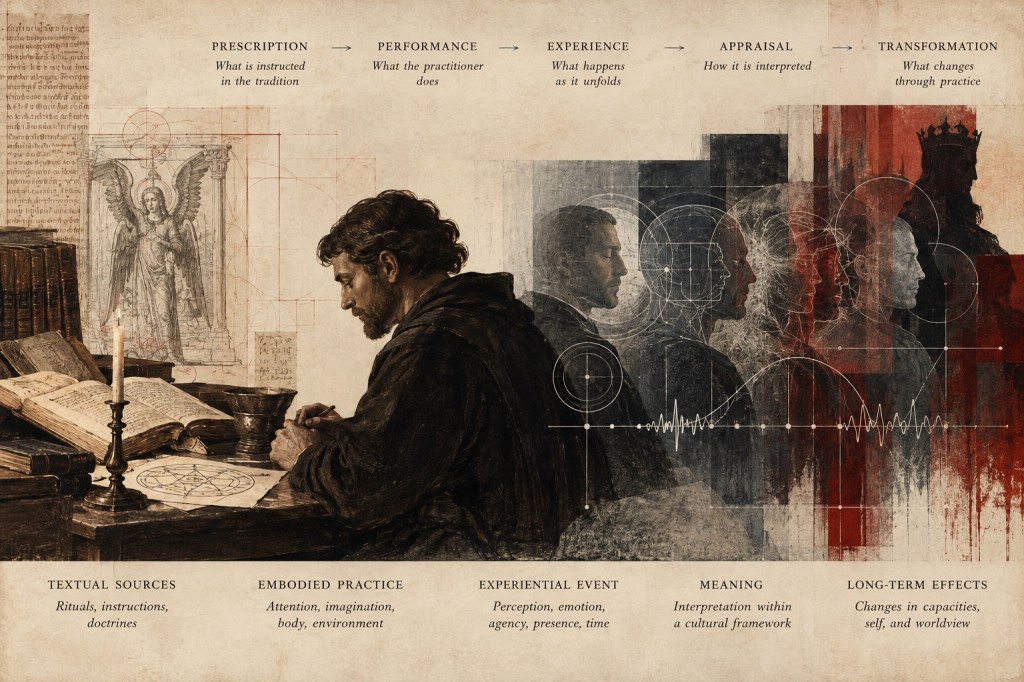
For our purposes, the sequence can be represented as:
prescription → performance → event → appraisal → repetition → transformation
A manual prescribes something. The practitioner performs it. Something is experienced. The event is interpreted. The practice is repeated. Over time, the practitioner and the experience may change.
That sequence is much more informative than collecting isolated stories of extraordinary events.
A medieval example
The academic article we are preparing uses the medieval monk John of Morigny as one example.
John was a Benedictine monk active in the early fourteenth century who practised material associated with the Ars notoria, a ritual tradition concerned with obtaining knowledge and intellectual abilities through prayer and visionary practice.
In one report he describes praying late at night, lying down, falling into what he calls an ecstasy, hearing a voice “like many waters” and “like a trumpet,” and then awakening while the voice still seemed to ring in his ears.
The report is remarkable, but when analysed closely it becomes clear that it tells us a great deal about some dimensions and almost nothing about others. The auditory component is richly described, yet we learn little about bodily sensation, attention, spatial location or the exact change in his sense of self.
That distinction matters because historical narratives can appear phenomenologically richer than they actually are. A source may contain extensive theology and symbolism while providing surprisingly little detail about the structure of the experience itself.
Historical research also imposes a simple but crucial discipline. When John does not mention a bodily sensation, we cannot conclude that there was none. We can only say that it was not reported.
PEER therefore distinguishes between what a source explicitly reports, what it does not report and what a researcher may cautiously infer.
Why living practitioners are different
The situation is obviously different when the practitioner is alive.
A researcher can ask follow-up questions. Where exactly did the image appear? Were the eyes open or closed? What happened immediately before the voice? Did breathing change? Did the practitioner deliberately produce the figure? When did it begin to seem autonomous? When was the interpretation formed?
This gives us an opportunity that historians rarely possess.
It also makes careful interviewing important, because poorly phrased questions can themselves shape the answer. If a researcher asks, “When did the spirit enter the room?” the question already assumes both a spirit and an entry. A better question might be, “You said that at some point you felt that something was present. Can you describe what changed immediately before you had that impression?”
The language used to investigate experience therefore matters.
Our own practical work
Our interest in these questions has not developed only through reading historical and theoretical literature.
We have also worked with documented ritual practice ourselves.
In an earlier first-person study centred on an Abraxas operation, ritual preparation, sigil construction, an evocatory formula, changes in consciousness and the subsequent interpretation of the resulting material were documented as separate stages. Parts of the process were also preserved on video. Meanwhile we published a book on the entire Abraxas Opertion: Abraxas Revived.
This kind of material is particularly valuable methodologically because the researcher does not have to reconstruct the entire process from a later anecdote. The prescription can be compared with the actual performance, the performance with the reported event, and the event with the interpretation that followed.
It also shows why apparently simple statements such as “the ritual worked” are inadequate for serious analysis. What exactly happened? At what moment? Which aspects had been prescribed? Which arose unexpectedly? Which changed with repeated practice? What was experienced immediately, and what was interpreted only afterwards?
Those questions helped lead us toward PEER.
Magic as a historical laboratory of consciousness
There is a broader reason why all of this interests us.
Magical traditions can be viewed as historical laboratories in which human beings have experimented for centuries with attention, imagery, symbolism, expectation, breathing, bodily states, sensory deprivation, repetition and altered consciousness.
Calling them laboratories does not mean accepting every magical theory or claim. Some techniques may do very little. Some experiences may be strongly shaped by expectation. Some reports may be exaggerated or retrospectively reconstructed.
Yet it would be equally premature to assume that systematic practices maintained over generations have nothing to teach us about human cognition and experience simply because their traditional explanations involve spirits, subtle forces or divine beings.
Modern research on meditation has already shown that repeated mental training can alter attention, perception, emotional regulation and the sense of self. Magical practices deserve the same kind of careful descriptive scrutiny.
Between belief and dismissal
The study of unusual experience has often been trapped between two unsatisfactory extremes.
One approach takes the practitioner’s interpretation literally and concludes that an angel, spirit or magical force must have been present.
The opposite approach assumes from the outset that such reports are nothing more than fantasy, error or pathology.
A phenomenological and praxeological approach allows another possibility. It treats the experience seriously without immediately deciding what the experience ultimately was.
The practitioner can retain the meaning of the event.
The scholar can retain methodological caution.
Both can begin with the same question: what happened, as precisely as we can establish it?
That modest question can take us surprisingly far.
Where we are going next
We are currently preparing an academic publication in which the PEER method will be presented formally within the developing praxeology of esoteric practices and related to research on nonordinary experience, microphenomenology and first-person methods.
Alongside the article we have developed two practical research instruments.
PEER-P is designed for prospective or elicited reports. It can be completed shortly after ritual, meditation or another practice, or used by a researcher when interviewing a practitioner.
PEER-R is intended for retrospective and historical material, including magical diaries, autobiographies, ritual records and older textual sources.
The next phase is empirical. The protocol has to be used on real material so that we can see whether its dimensions remain useful, whether independent researchers identify the same events, whether changes across repeated practice can be detected reliably and which forms of comparison actually yield new knowledge.
That work will also force the protocol itself to develop, because a serious method should be shaped by the material it encounters rather than protected from it.
The larger aim is therefore quite simple. Magic has generated extraordinary claims for centuries, but before deciding whether those claims should be believed or rejected, there is another task that has received surprisingly little systematic attention: to describe carefully what people actually do, what they actually report experiencing, how they interpret those experiences and what changes when the practice is repeated.
That is where praxeology and phenomenology meet, and it is also where a serious empirical study of magical practice can begin.

