E. W. Dobberkau on Imagination, Suggestion and the Experimental Formation of Experience
Among the contributions to the first volume of the Zentralblatt für Okkultismus that speak most directly to the concerns of The Inner Laboratory is E. W. Dobberkau’s Magische Experimente der Willenskraft als Einleitung in den Okkultismus. The article appeared in 1907 in the section devoted to experimental and practical occultism, where Dobberkau attempts to describe a reproducible entrance into a field that was otherwise largely dependent on exceptional and unpredictable experiences. The position of the essay within the journal is significant. Occultism is presented here as something that can be approached through practice, observation and deliberate changes in consciousness.
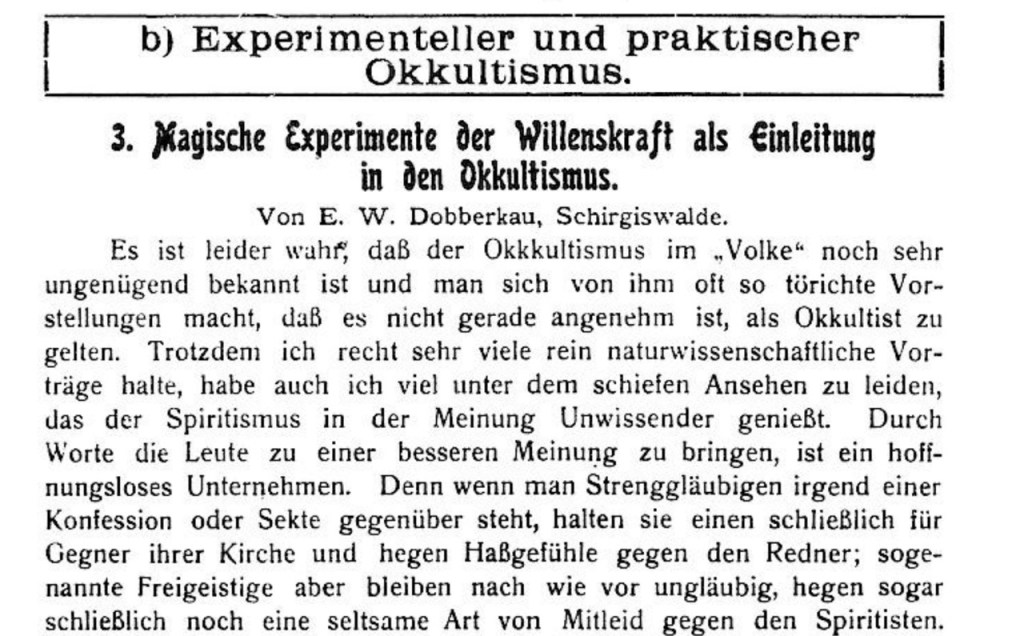
Dobberkau begins from his own experience as a clairvoyant. He is convinced that clairvoyance can provide evidence of a supersensible world, but immediately encounters a practical difficulty. The phenomenon cannot be summoned at will:
“Vielfach bin ich in der günstigen Lage, als Hellseher einen Beweis von der Welt des Übersinnlichen zu geben. […] Aber leider ist die Hellsehergabe gänzlich unabhängig vom Willen: sie kommt und geht, ganz unberechenbar; oft, wenn man sie am wenigsten erwartete, ist sie da, wenn man sie aber einmal herbei wünscht, bleibt sie fern.”
Zentralblatt für Okkultismus, 1907, p. 540.
The passage contains the problem from which the rest of the experiment develops. Dobberkau wants to move from a spontaneous phenomenon to one in which the experimenter can actively establish the conditions under which unusual experiences arise. Clairvoyance, as he understands it, is unsuitable because it remains independent of conscious intention. His attention therefore shifts towards what he calls magische Willensbeeinflussung, magical influence through will.
This shift from reception to deliberate intervention is especially interesting. It places the human subject in a different relation to inner experience. Instead of waiting for something exceptional to occur, the experimenter begins to organize the conditions of consciousness.
The cultivation of will
Dobberkau assumes that latent capacities can be developed through practice. He writes:
“Es gibt ja hierüber schon so vorzügliche Lehrbücher, daß bei einiger Begabung und festem unverdrossenem Willen jeder Okkultist jene inneren magischen Kräfte in sich zur Entfaltung kommen lassen kann und es auch tun sollte.”
He then describes the principle underlying his own experiments:
“Bei meinen Experimenten gehe ich stets von suggestiver Willenseinwirkung aus, ohne jedoch die üblichen Methoden des Hypnotismus anzuwenden.”
Zentralblatt für Okkultismus, 1907, p. 540.
The phrase suggestive Willenseinwirkung deserves attention. Dobberkau himself identifies suggestion as part of the mechanism, although he distinguishes what he is doing from conventional hypnosis. The experiments involve an interaction between intention, expectation, attention and the responsiveness of the participant. His occult interpretation concerns the transmission of will as a force, but the procedure he describes contains processes that can be considered independently of that interpretation.
This becomes clearer when he later explains what successful willing requires:
“Bedingung ist dabei nur: Klarheit des Wollens und nur einen einzigen Gedanken hegen, den man auf das Medium übertragen will.”
Zentralblatt für Okkultismus, 1907, p. 542.
Klarheit des Wollens, clarity of willing, is accompanied by the capacity to maintain a single thought. Will is therefore not presented simply as effort or determination. It is a disciplined organization of consciousness. Competing mental contents are reduced while one intention is held steadily in attention.
Read in this way, Dobberkau’s magical will begins to resemble something much more familiar. Concentrative meditation, hypnotic suggestion, visualization and many forms of contemplative practice depend upon the ability to stabilize attention around a restricted field of experience. The terminology has changed considerably, but the basic observation remains recognizable: what is continuously held in attention can begin to reorganize the wider field of experience.
This is close to what The Inner Laboratory calls the Operator. The Operator is the capacity to intervene consciously in the configuration of experience by directing attention, forming an image, altering breathing or bodily state, and sustaining an intention long enough for its effects to become perceptible.
Dobberkau gives us an early occultist formulation of this principle.
Constructing an encounter
The most revealing section of the article begins when Dobberkau describes an experiment involving a deceased loved one. He first asks the participant whether there is someone among the dead whom they would dearly like to see again. He is fully aware of the emotional intensity of this question:
“Immer hat der Mensch einen derartigen heißen Wunsch auf dem Herzen!”
He then tells the participant that the deceased person will now become visible. He places his hands over the participant’s eyes, positions the head against his chest and begins speaking in a calm, subdued voice:
“Sie sehen einen hellen Schein. Er kommt langsam näher. Sehen Sie recht genau hin: es ist Ihr lieber Verstorbener. Bitten Sie ihn nun recht innig voll festen Vertrauens, er solle sich Ihnen recht deutlich zeigen. Er soll an Sie herantreten, soll unmittelbar vor Ihnen stehen.”
Zentralblatt für Okkultismus, 1907, p. 541.
Whatever one thinks of Dobberkau’s explanation, the structure of the experiment is remarkably clear.
He begins by identifying an emotionally charged person whose appearance carries enormous significance for the participant. Normal visual input is then reduced by closing or covering the eyes. Attention is narrowed. A simple visual phenomenon is introduced, a bright light. The light is given direction and movement as it approaches. It is then identified with the deceased person. Finally, the participant is encouraged to address the figure inwardly and invite it to come closer.
The experience is therefore carefully scaffolded.
Memory, grief, desire, expectation, bodily proximity, sensory reduction, verbal suggestion and imagery converge upon one inner event.
This is precisely why Dobberkau’s description is so valuable. It allows us to observe the construction of what might be called an imaginal encounter space.
The word construction need not imply that the resulting experience is trivial or insincere. Dobberkau reports the opposite. Participants remember what occurred and describe the apparition with striking vividness:
“Es hat letzteres noch den sehr großen Vorteil, daß mein Medium sich all des Gesehenen vollständig erinnert und nun ganz genau erzählen kann, wie lebhaft die Gestalt des lieben Verstorbenen vor ihm stand. ‘Wie lebend!’ Das ist gewöhnlich sein Ausdruck.”
Zentralblatt für Okkultismus, 1907, p. 541.
The phrase wie lebend, as if alive, is important.
The experience has acquired perceptual force. Something that began within a deliberately constructed procedure has become sufficiently vivid to be experienced with qualities normally associated with encounter rather than voluntary fantasy.
This is where Dobberkau and The Inner Laboratory begin to diverge.
Vividness and truth
For Dobberkau, the vividness of the experience has evidential weight. He continues:
“Und das ist es gerade, was so sehr tiefen Eindruck auf die bisherigen Gegner macht. Es wagt danach keiner mehr, Zweifel zu hegen an der Wahrheit und Wissenschaftlichkeit einer Weltanschauung, die ihren Vertretern Kräfte verleiht, so Großes in so einfacher Weise auszuführen.”
Zentralblatt für Okkultismus, 1907, p. 541.
The passage exposes an epistemological problem that remains central to every serious investigation of unusual states of consciousness.
An experience may be extraordinarily vivid without the explanation attached to it being established.
A person can genuinely experience the presence of a deceased relative. The experience can possess depth, emotional force and perceptual immediacy. None of this determines by itself whether the source of the experience is memory, suggestion, unconscious image formation, a dissociative process, an altered mode of perception or something that exceeds the individual psyche.
Dobberkau moves almost immediately from phenomenological intensity to ontological confirmation. The apparition feels alive, therefore the experiment becomes evidence for the Welt des Übersinnlichen.
The Inner Laboratory places a deliberate interval at this point.
The experience itself is preserved intact. The participant saw what was seen, felt what was felt and encountered what seemed to be present. The explanatory question remains open.
This distinction is one of the functions of the Witness.
The Witness allows an experience to become fully present without requiring an immediate verdict about its ultimate nature. This becomes increasingly important as experiences acquire intensity, because subjective certainty often grows faster than objective evidence.
Dobberkau shows us both sides of the problem. His experiment demonstrates how powerful an intentionally constructed experience can become, while his interpretation shows how easily experiential vividness can be converted into metaphysical certainty.
Imagination as an actively formed interface
The experiment becomes particularly relevant when imagination is understood as an interface rather than as a collection of private pictures.
An interface is itself constructed, yet construction does not make it meaningless. A scientific instrument is constructed. A language is constructed. A computer interface is constructed. Each creates a particular form through which something otherwise inaccessible can enter experience.
The imaginal interface works differently, because the instrument and the field of observation partly occupy the same nervous system. Nevertheless, the underlying principle is comparable. Conditions are deliberately established that permit certain phenomena to become available to awareness.
Dobberkau’s sequence offers an unusually concrete example.
The participant brings memory and longing. The experimenter organizes attention and expectation. Sensory competition is reduced. An initial image is supplied and progressively elaborated. The participant then begins to experience within that field.
At some point the distinction between what was deliberately introduced and what subsequently emerges may become less obvious.
This is the point at which imagination becomes especially interesting for The Inner Laboratory.
A practitioner may intentionally create a light, a geometrical form, an inner landscape or a figure. That first form is clearly authored. Continued attention may then evoke associations, bodily sensations, memories, emotions and further images that were not deliberately specified. Sometimes the resulting experience acquires a degree of autonomy and begins to feel encountered rather than invented.
The initial act of imagination has created the conditions for an event whose later development is only partly governed by conscious intention.
This is what we mean when we speak of imagination as an actively formed encounter space.
The formulation avoids the premature conclusion that whatever appears must exist independently in some metaphysical realm. It also avoids reducing the experience to meaningless fabrication merely because imagination participated in producing the conditions under which it arose.
Something has been constructed, and something has happened within the construction. The epistemological work begins there.
The Operator does not determine the outcome
Dobberkau’s own distinction between clairvoyance and will provides another useful insight. He begins the article by admitting that his clairvoyant experiences cannot be commanded. His subsequent experiments seek greater control, yet even here the experimenter does not manufacture every detail of the resulting experience.
This distinction allows us to formulate the Operator more precisely. The Operator creates conditions. It does not necessarily create the entire content that subsequently appears.
A gardener can prepare soil, control water and establish conditions favourable to germination without constructing the plant leaf by leaf. The analogy is imperfect, but it captures something essential about trained imagination. The practitioner shapes the field in which an experience can develop while remaining unable to predict everything that will arise within it.
The appearance of unforeseen material is therefore not mysterious in itself. Consciousness contains memory, affective associations, implicit knowledge and perceptual processes far beyond what is present in deliberate thought at any particular moment.
Whether an imaginal encounter can ever disclose something that cannot be explained within those resources remains a further question. A rigorous method should preserve the possibility without assuming the answer.
Dobberkau assumes the answer rather quickly. His experiment remains interesting because the procedure itself survives the weakness of the conclusion.
Experience as method
Near the end of the article Dobberkau makes another statement that deserves to be retained:
“Die beste Anleitung allerdings ist immer die Erfahrung.”
He advises readers to test what they have read experimentally, preferably upon themselves:
“Ich kann es daher jedem nur raten, alles Gelesene auch sofort experimentell auszuprüfen; wenn nicht an sich selbst, was immer das beste ist, so doch aber gemeinsam mit gleichstrebenden Freunden…”
Zentralblatt für Okkultismus, 1907, p. 542.
He then adds a qualification that is almost as interesting as the recommendation itself. The necessary conditions must be properly fulfilled because, as he admits, the laws governing the supersensible world are still too poorly known to predict its operation reliably.
Here Dobberkau arrives close to a methodological position that can be retained while his metaphysics is suspended.
Experience becomes primary because the territory is insufficiently understood.
The Inner Laboratory takes one further step. Experience becomes primary precisely because the nature of the territory has not yet been established.
That difference matters.
Dobberkau already knows that the übersinnliche Welt exists and wants experiment to reveal its laws. Our starting position is more agnostic. We know that deliberate practices involving attention, imagination, breath, expectation and bodily state can produce profound alterations in experience. We can study their structure, repeat them, compare them and observe their consequences. We do not have to settle the ultimate ontology of everything encountered before that investigation begins.
A historical precursor of the Inner Laboratory
Dobberkau’s article is therefore valuable today in a somewhat different way from the one he intended.
His experiments provide weak evidence for the metaphysical claims he wanted to establish. They provide much stronger evidence of a historically important attempt to learn how consciousness can be deliberately configured.
He recognized that intention can be concentrated. He understood that imagery becomes more powerful when attention is stabilized. He deliberately used emotional significance and expectation to deepen an experience. He observed that internally generated figures could acquire extraordinary vividness. He also believed that practice should be grounded in direct experiment rather than textual authority alone.
Those elements place his work surprisingly close to several concerns of The Inner Laboratory.
The central difference is methodological restraint.
The Operator establishes the conditions for the experiment. The Witness remains present while the experiment unfolds. The first allows experience to deepen; the second prevents the meaning of that experience from being decided too quickly.
Together they permit something that Dobberkau’s procedure already approaches but does not fully achieve: an experimental practice in which the imaginal field can be entered seriously while remaining epistemologically open.
More than a century after Dobberkau wrote about magische Willenskraft, the language of magical forces may no longer be necessary to preserve what was most interesting in his experiment. His work points towards a more fundamental human capacity: the ability to organize attention, intention and imagination until the ordinary configuration of experience begins to change.
At that threshold, deliberate construction can give way to unexpected experience, and imagination can begin to function as an encounter space.
What is encountered there cannot be decided by intensity alone. It can only be investigated. That may be the enduring value of Dobberkau’s experiment.

