Reading the First Volume of the Zentralblatt für Okkultismus, 1907
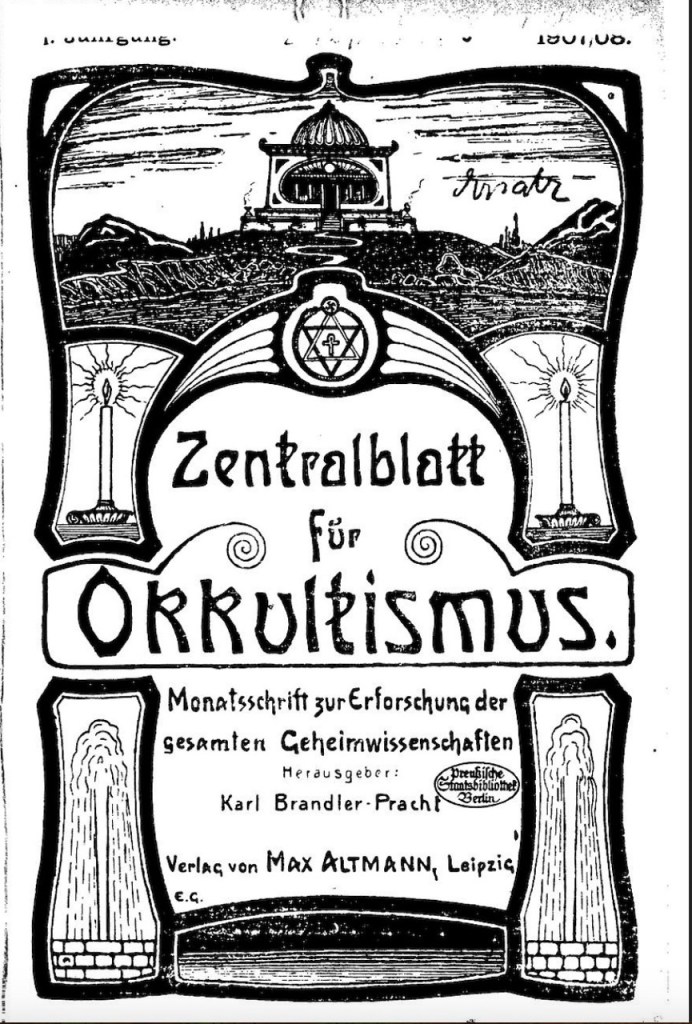
Opening the first volume of the Zentralblatt für Okkultismus from 1907 means entering an intellectual landscape that has almost entirely disappeared. The journal carried the subtitle Monatsschrift zur Erforschung der gesamten Geheimwissenschaften, a monthly review devoted to the investigation of the entire field of the secret sciences. The choice of the word Erforschung, investigation, is revealing. The editors presented occultism as a domain of inquiry whose phenomena had not yet been adequately incorporated into established forms of knowledge.
From a contemporary perspective, many of the subjects treated in the journal are difficult to accept on their own terms. Astrology, dowsing, animal magnetism, astral bodies, mediumship and various spiritualist phenomena are discussed within conceptual frameworks that often rest on speculative assumptions. Yet the historical significance of the journal becomes clearer when it is read as an attempt to define a field that had not yet been divided into the disciplinary compartments that later became familiar. Psychology, physiology, religious philosophy, spiritualism, natural science and metaphysics still overlap continuously.
The result is an unusual intellectual space in which questions about dreams, immortality, magnetic influence, the structure of matter and the nature of consciousness can appear within the same research program.
A remarkably broad conception of science
The table of contents already makes the ambition of the journal visible. Its first major section is titled Wissenschaftlicher Okkultismus, scientific occultism, and this is further divided into Theoretisches und Kritisches and Experimenteller und praktischer Okkultismus. Within these categories one finds essays on individuality, dreams, immortality, alchemy, dowsing, astrological techniques, tidal phenomena and experiments concerning the force of will. Other sections are devoted to spiritualism, Theosophy, Indian mysticism, Buddhism, magnetism, mediumship, natural modes of life, literature, correspondence and book reviews.
The range of subjects appears heterogeneous to a modern reader because contemporary culture has learned to separate these areas sharply. Physics belongs to one domain, psychology to another, theology to another, and occult traditions have largely been excluded from all three. The Zentralblatt inhabits an earlier moment in which these boundaries were still porous enough for an author to discuss the divining rod in physical terms, Schopenhauer in relation to Indian philosophy, and dreams as possible evidence for forms of perception that exceeded waking consciousness.
This broadness rests on a particular view of nature. The authors frequently assume that the known physical world represents only part of what nature contains. A phenomenon that cannot yet be explained by established science may still belong to nature, provided that its laws have not yet been discovered.
This idea gives the journal much of its coherence.
Occultism as an expanded natural science
The position is stated with particular clarity in Dobberkau’s essay “Der Okkultismus als erweiterte Naturwissenschaft”, “Occultism as an Expanded Natural Science.” The title itself contains the program.
E. W. Dobberkau-Widar was a German occultist writer, editor, and psychical researcher active in the early twentieth century. His work sought to connect personal experience and disciplined self-observation with a more systematic investigation of mediumship, clairvoyance, dreams, and other phenomena then grouped under the broad heading of occultism. This combination of first-person experience and an explicitly investigative attitude makes him a particularly revealing figure within the intellectual world of the Zentralblatt für Okkultismus.
Dobberkau treats occult research as a possible extension of natural science into regions that remain insufficiently explored. He appeals to the history of science, where unfamiliar phenomena and unconventional theories have repeatedly encountered resistance before being incorporated into accepted knowledge.
This way of thinking is important because it reveals that the authors do not generally understand occultism as a rejection of science. Their criticism is directed at what they regard as premature closure. They suspect that contemporary science has confused the boundaries of its present methods with the boundaries of reality itself.
The distinction between the unknown and the supernatural is therefore crucial. What is called occult may simply be hidden. The task of research is to discover whether apparently anomalous phenomena belong to a larger natural order.
This expectation also appears in the treatment of the divining rod. The discussion seeks analogies with electricity, radioactivity, radiation and magnetic processes. The proposed connections are speculative and would not satisfy present scientific standards, yet their intellectual direction is unmistakable. The author wants to translate an old occult practice into a causal account of nature.
The journal therefore occupies a transitional landscape in which nineteenth-century concepts such as ether, magnetism and vital force coexist with newer developments in electricity, radioactivity, physiology and experimental observation. Scientific discoveries are repeatedly appropriated as possible models for phenomena that remain unexplained.
That mixture is historically revealing. It shows a culture trying to enlarge its picture of nature at a moment when the foundations of physics, psychology and biology were themselves changing rapidly.
The dream as a field of research
The journal becomes especially interesting when its attention turns toward inner experience.
In “Der Traum und seine Stellung zum Okkultismus”, “The Dream and Its Position within Occultism,” W. W. Ernst Friedel approaches dreaming as a phenomenon deserving sustained investigation. He considers the relation between bodily stimuli and dream imagery, the transformation of sensory impressions during sleep and the emergence of images that are not consciously produced.
A central question begins to appear here: how should we understand experiences whose contents arise within the subject while seeming to possess a degree of autonomy?
A dream image belongs to the dreamer, yet the dreamer often experiences it as something encountered rather than deliberately composed. The image can surprise, resist and develop according to its own logic. This tension between authorship and reception would later become fundamental in depth psychology, particularly in the work of Jung.
Friedel moves beyond psychological description and considers the possibility that some dream phenomena may arise through influences that exceed the individual mind. From a contemporary perspective, this is precisely where the text becomes epistemologically vulnerable. The transition from experience to explanation occurs quickly, and the existence of an unusual phenomenon is sometimes treated as support for a larger metaphysical hypothesis.
Still, the initial gesture remains significant. Inner experience is granted the status of evidence worthy of investigation.
This is one of the most interesting aspects of the journal. Around 1907, the boundaries between psychology, mysticism, psychical research and occultism had not yet hardened. Experiences of autonomous imagery, altered perception and unusual states of consciousness could still be discussed within several explanatory frameworks at once.
Later, psychology would increasingly interpret such material within the dynamics of the psyche, while occult and spiritualist traditions would remain open to the possibility that some experiences referred to realities beyond the individual subject.
The first volume of the Zentralblatt belongs to the moment before that separation became decisive.
What counted as an experiment?
The heading “Experimenteller und praktischer Okkultismus” deserves careful attention because the term experiment is used more broadly than it would be in contemporary scientific practice. It can refer to repeated observation, technical calculation, practical testing or the systematic application of a method.
The astrological material illustrates this clearly. The journal contains elaborate procedures involving directions, significators, promissors and astronomical calculations. The technical precision can be considerable.
Such precision creates an appearance of scientific discipline, yet accuracy within a procedure does not establish the validity of the assumptions on which that procedure depends. A method can be internally exact while remaining empirically unverified.
This distinction becomes one of the central epistemological lessons of the volume.
The authors often display genuine methodological seriousness. They want observations to be repeated, cases to be compared and unexplained effects to be approached systematically. At the same time, the criteria for excluding alternative explanations are frequently weak, and hypotheses are allowed to become ontological claims before the evidential foundation has become secure.
The journal therefore stands in an intermediate position. It has moved some distance from pure doctrine, while the methods of modern experimental science have not yet been fully absorbed.
That tension gives the material much of its historical value.
The problem of authority
Another theme running through the first volume is suspicion of intellectual authority. Established science is repeatedly accused of dismissing unfamiliar phenomena because they do not fit existing theories.
Dobberkau develops this argument through historical analogy. Scientific progress has often required investigators to enter fields that respected authorities initially considered implausible. He therefore encourages researchers to approach occult phenomena without fear of ridicule or reputational damage.
There is a legitimate epistemic principle here. Knowledge can only expand if unexplained phenomena remain open to investigation.
The difficulty begins when historical persecution itself is treated as evidence of future vindication. The fact that some once-rejected ideas eventually proved important offers no guarantee that every marginalized theory contains a hidden scientific revolution. This pattern would become familiar throughout the later history of fringe science.
The intellectual strength of the Zentralblatt lies in its willingness to keep inquiry open. Its vulnerability lies in the absence of sufficiently strong procedures for deciding when a hypothesis has failed.
That combination is worth remembering because it remains relevant far beyond the history of occultism.
A lost intermediate world
Taken as a whole, the first volume reveals a surprisingly coherent intellectual project. Occultism is treated as a provisional science of phenomena for which the current conception of nature may be too narrow.
Direct experience occupies a central position within this project. Dreams, unusual bodily sensations, mediumistic events, altered states and anomalous perceptions are treated as material that deserves attention. Alongside this empirical interest stands a strong desire for system, experiment and theoretical explanation. The various findings are then brought into contact with larger philosophical questions concerning individuality, immortality, consciousness and the relation between mind and matter.
This creates a form of inquiry that later became difficult to sustain. The twentieth century progressively separated the relevant domains. Psychology professionalized, physics became increasingly mathematical and experimental, religious studies developed its own methods, and occultism was largely displaced from academic discourse.
The Zentralblatt preserves an earlier moment in which these territories could still be imagined as parts of one unfinished map.
Its weaknesses are plain. Experience, interpretation and metaphysical commitment often merge too easily. An unexplained event can acquire an elaborate ontology before the character of the event itself has been established with sufficient care.
Yet beneath the dated theories lies a question that has lost little of its force:
How should we investigate experiences that do not fit comfortably within our existing model of reality?
The problem requires openness, because an unexplained phenomenon cannot be understood if it is dismissed in advance. It also requires restraint, because an experience does not become evidence for a metaphysical system merely by being powerful, unusual or difficult to explain.
The first volume of the Zentralblatt für Okkultismus shows a generation of investigators struggling with precisely this balance.
More than a century later, our scientific vocabulary has changed and our methodological standards have become considerably more demanding. The underlying epistemological problem remains recognizable. Human beings continue to report experiences of unusual presence, autonomous imagery, altered states of consciousness and forms of meaning that resist easy classification.
The old journal does not provide reliable answers to those questions. Its historical importance lies elsewhere. It documents an ambitious attempt to keep the mysterious within the horizon of inquiry and to imagine that the unknown might still be investigated without first deciding what kind of reality it belongs to.
That intellectual attitude may ultimately be more valuable than many of the theories the journal advanced.

