A landscape begins to change when we stop experiencing it as scenery. Hereunder is a segment of our landscape at the Quinta Quixote, where the elemental of the tree can be seen with our imaginative eye…
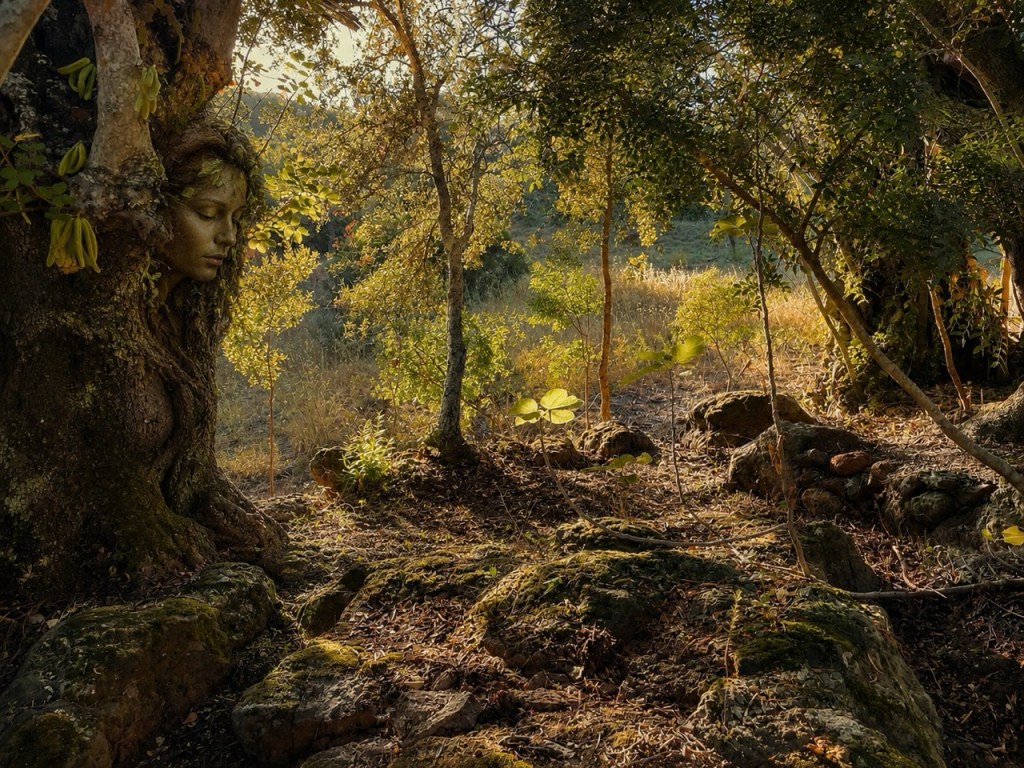
The stones, trees, paths, springs and contours of a place are ordinarily arranged by perception into a world of objects. We move through them, identify them and use them to orient ourselves. A tree is a tree, a rock is a rock, and a path leads somewhere. Yet throughout human history landscapes have also been experienced in another way. Particular trees could possess presence, springs could demand respect, stones could mark thresholds, and certain places seemed capable of entering into a relationship with the people who approached them.
Our work with landscape phenomenology has gradually moved towards this relational dimension. The question is no longer limited to what a place looks like or what historical functions may once have been assigned to it. We are interested in what becomes perceptible when attention changes, when movement slows, when the body participates more consciously in perception and when imagination is allowed to become part of the encounter.
An unexpected historical companion to this inquiry appears in the twenty-fifth volume of the Zentralblatt für Okkultismus (1931). In his article “Baumgeister und Krankheitsdämonen,” (p127- 131) Dr. J. Nistler collected traditions concerning tree spirits, healing trees, sympathetic cures and practices through which people attempted to establish direct contact with what they understood as the living presence of trees.
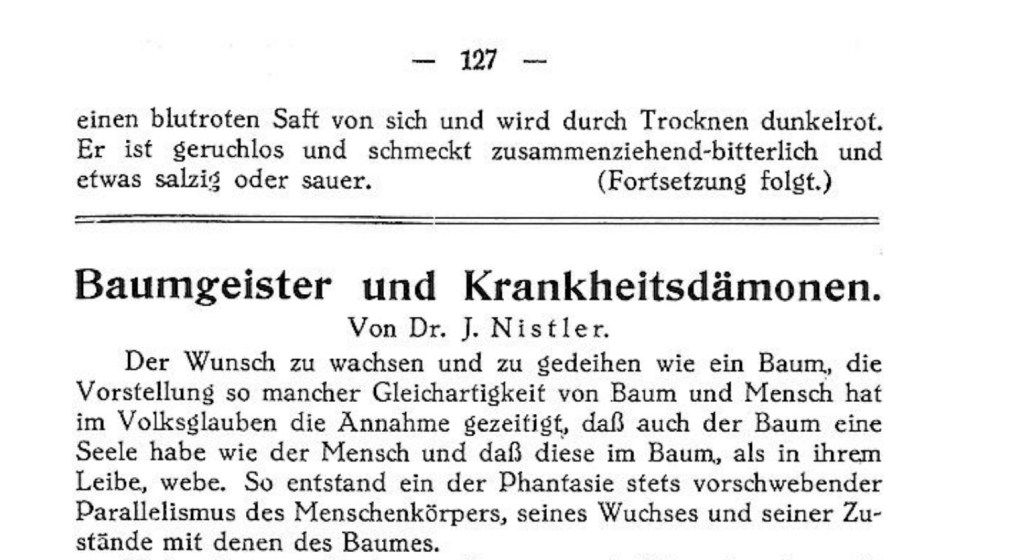
Much of Nistler’s explanatory framework belongs unmistakably to the occultism and folklore of his period. He speaks about tree souls, magnetism, radiation and spirits of disease in a language that we need not adopt. Yet behind these interpretations lies a remarkably coherent phenomenology of the relationship between human beings and the living landscape.
It begins with a simple perception: the tree resembles us.
The tree as another form of life
Nistler opens with the old analogy between the growth of a human being and the growth of a tree. Both begin small, develop a characteristic form, suffer damage, recover, age and eventually die. From this parallel emerged the widespread idea that the tree might possess something corresponding to the human soul.
The consequences of such an idea are greater than they initially appear.
Once the tree is experienced as a living counterpart rather than as neutral material, behaviour towards it changes. Nistler records traditions in which cutting into the bark is treated almost as an injury to flesh. Woodcutters may ask forgiveness before felling an old tree. Stories tell of trees bleeding when struck by an axe and of people becoming terrified when the expected boundary between plant and person momentarily dissolves.
Whether these stories describe physical events is less important for our purpose than the form of relationship they reveal. The tree has entered the moral field.
One does not ask forgiveness from an object.
The act of apology establishes the tree as a participant in an encounter. Human action is no longer unilateral. Something is acknowledged on the other side of the relationship.
This provides a useful principle for landscape phenomenology. Attention changes when the element being observed is approached as something towards which courtesy may be appropriate. The difference can be subtle, but it alters the structure of perception. Looking at a tree and presenting oneself to a tree are different acts of consciousness.
A living landscape may begin precisely there.
The tree as a centre of place
Nistler also describes trees that functioned as protectors of a household or an entire community. Lime trees, oaks, cherry trees and junipers could become Schutzbäume, trees in which the protective life of a family or village was concentrated. A village lime might represent something larger than an individual tree. It could become a visible focus for the continuity and identity of the community.
This gives the old concept of genius loci a particularly concrete form.
The spirit of a place need not be imagined as an invisible atmosphere distributed equally across an entire landscape. Human experience often concentrates significance. A spring, an ancient stone, a cave or a particular tree can become the point around which the character of a place gathers.
This is worth investigating within our own landscape project.
Old trees growing within an archaeological or megalithic environment are often treated as later additions to a site whose true significance lies in stone. Phenomenologically that assumption may be misleading. A tree that has grown for centuries among ancient stones has become part of the perceptual structure of the place. Its roots enter the soil beneath the stones, its crown alters light and temperature, its trunk provides an axis that changes orientation and scale.
The question then becomes empirical in the original meaning of the word: what happens in experience?
Does attention change near particular trees?
Does the bodily sense of a place change beneath their canopy?
Does the relation between enclosure and openness change when a vertical living form appears among horizontal or weathered stones?
Does one tree repeatedly attract attention without conscious intention?
These observations require no doctrine of tree spirits. They require only sufficient patience to notice whether the experiential field varies from one part of the landscape to another.
Sympathy and the joining of destinies
Among the strangest practices described by Nistler are traditional cures in which the condition of a person becomes ritually connected with the condition of a tree.
A young tree might be split and held open while a sick child was passed through it. Afterwards the tree was bound together again. As the wound in the tree healed, the child’s disorder was expected to heal with it. In other traditions a child suffering from impaired growth was passed beneath the arch of a root or through brambles whose upward growth became symbolically connected with the child’s own development.
The operative principle is what earlier anthropology called sympathetic magic. Similarity and association establish a relationship between two processes. Healing in one domain is linked to healing in another.
For a contemporary observer, the medical claims of such practices remain separate from their phenomenological significance. The ritual performs an extraordinary operation upon experience. Something previously confined to the body is given an external form in the landscape.
Illness acquires a location.
Healing acquires an image.
The tree becomes the visible counterpart of a process taking place within the person.
This may help us understand one of the enduring functions of ritual. Human beings often find it difficult to work directly with experiences that have no clear shape. Fear, grief, illness, transition and loss may be deeply felt while remaining difficult to grasp. Ritual places these conditions into space. A stone can receive something. A path can be crossed. A threshold can be passed. A tree can embody recovery.
The landscape becomes a language through which an inner process can be encountered from outside.
This principle is highly relevant to our work with imaginal space. The symbolic form is deliberately created, while the psychological experience that unfolds through it may exceed what was consciously planned.
The transfer of suffering
Nistler’s account becomes more explicit in the practices intended to transfer disease into a tree. Illness is addressed as though it were capable of movement. It can be ordered into the forest, placed in an oak, transferred to an elder branch or carried away by a bird.
The structure of these practices is spatial.
A condition moves from here to there.
The ritual thereby transforms an invisible bodily state into an imagined trajectory through the environment. The landscape participates because it provides locations capable of receiving, containing or transforming what the person wishes to release.
Again, the historical claim that a disease literally migrated into a tree need not be accepted in order to appreciate the experiential mechanism. The act creates a concrete relation between bodily sensation, imagination, movement and place.
In the terminology of the Inner Laboratory, the landscape becomes part of the interface.
An internal state is given imaginal form, connected to a physical element and then worked with through embodied action. The practitioner is no longer thinking about change abstractly. Change has acquired direction, gesture and location.
This may be one of the oldest functions of magical landscapes.
Breath and the tree
The passage in Nistler’s article that comes closest to our own experimental work concerns direct contact with trees.
He recommends seeking solitary places and approaching old beeches or oaks. The practitioner places the palms against the trunk and begins breathing deeply while attempting to einfühlen, to feel into the being of the tree. He suggests remaining there for around twelve minutes, accompanying each breath with an inward request for the tree’s strength and with gratitude for what is received.
The metaphysical explanation he gives concerns the radiation of the tree and the possibility of eventually perceiving nature beings. We can leave that interpretation open and look instead at the practice itself.
Its structure is remarkably sophisticated.
The practitioner leaves the socially saturated environment and enters relative solitude. A single tree is selected. Physical contact narrows the perceptual field. The palms provide continuous tactile information. Breathing becomes slower and more deliberate. Attention remains fixed upon one living organism for a period considerably longer than ordinary visual attention would normally remain there.
At the same time, an intentional attitude is cultivated. The practitioner is receptive rather than analytic. Gratitude accompanies perception.
Taken together, these elements create a distinct state of consciousness.
Breath regulates arousal. Touch anchors attention in the body. Sustained observation allows details that would normally be ignored to enter awareness. The imagined relation to the tree provides emotional and symbolic coherence.
After twelve minutes, the tree is unlikely to be experienced exactly as it was during the first ten seconds.
That fact alone makes the exercise worth examining.
Tree contact as an experimental practice
For the landscape project, Nistler’s account suggests a simple additional method.
A particular old tree within the site can be approached as a phenomenological station. Before touching it, the practitioner records the ordinary state of body and attention. The trunk is then contacted with both palms and the breath allowed to settle. No image of a tree spirit needs to be imposed. Attention can remain with texture, temperature, pressure, smell, sound, bodily sensation and whatever spontaneous imagery or affect begins to arise.
Ten or twelve minutes is sufficiently long for the ordinary naming function of perception to weaken.
At first there is likely to be bark, hand, wind, sound.
Later there may be qualities that are harder to categorize: heaviness, verticality, age, movement, enclosure, spaciousness, attraction, resistance, intimacy or distance.
These are phenomenological data.
If an image appears, it can be observed.
If a sense of presence develops, that too can be observed.
If nothing unusual happens, that is equally relevant.
The important distinction is that the experiment creates conditions for an encounter without prescribing what must be encountered.
Reciprocity
There is an ethical dimension in Nistler’s material that deserves particular attention.
When he describes the practice of transferring harmful influences from a patient to a tree, he adds that the tree should inwardly be asked for forgiveness. The practitioner should wish it strength, sunlight and flourishing in return.
Within Nistler’s occult framework this belongs to a magical economy of forces. From the perspective of landscape phenomenology it contains a more enduring insight.
Relationship requires reciprocity.
Modern spiritual culture can easily turn landscapes into resources. We visit sacred places to obtain energy, healing, insight or extraordinary experience. The place becomes another instrument for personal development.
A relational approach changes the question.
What does participation require from us?
Courtesy towards a landscape may sound strange until we notice how familiar the opposite attitude has become. We enter, photograph, consume, interpret and leave. The experience revolves almost entirely around the visitor.
A reciprocal practice introduces another orientation. The place is allowed to retain its own integrity. Nothing has to be extracted from it. Gratitude, care and restraint become part of the method.
This could be formulated as a basic principle for our project:
participation without extraction.
The landscape is approached as a field in which we temporarily participate rather than as a storehouse of experiences available for consumption.
The magic of silence
At the end of his article Nistler introduces another old magical principle: silence.
He advises the practitioner not to speak too readily about delicate experiences. His explanation is occult. Skepticism from others may disturb the emerging capacities of the student, while silence forms a protective circle in which these forces can develop.
There is a psychological insight hidden inside the magical language.
A new experience is often fragile. The moment we begin explaining it, we begin changing it. Language selects, organizes and fixes. Repeated narration gradually replaces the event itself with the story we have learned to tell about it.
For phenomenological work this is important.
Immediate documentation is valuable because memory begins reorganizing an experience almost at once. Immediate interpretation is less useful. The material benefits from a period in which it is allowed to remain unresolved.
Nistler’s Magie des Schweigens, the magic of silence, can therefore be reformulated as a discipline of incubation.
Record first.
Allow the experience to settle.
Interpret later.
Only after that should it become part of a public narrative.
Silence in this sense protects the primary experience from premature explanation.
From landscape to relationship
Nistler’s tree spirits belong to another intellectual world. His article moves without hesitation between folklore, occult magnetism, healing practices and literal nature beings. Our project does not need to adopt those conclusions.
What remains after suspending them is surprisingly rich.
The tree becomes a counterpart rather than an object. Certain trees become centres in the experiential structure of a place. Inner states can be given external form through symbolic relationships with elements of the landscape. Breath and touch can alter the mode in which those elements are perceived. Gratitude establishes reciprocity, while silence allows experience to mature before interpretation takes possession of it.
Together these practices describe a transition from landscape as environment to landscape as relationship.
Perhaps this is what earlier cultures meant when they spoke about spirits of place and souls of trees. Their ontological language may differ radically from ours, but the experience underlying it may begin with something surprisingly simple: prolonged attention to another living form until the ordinary distance between observer and observed becomes less absolute.
At that point the tree has not necessarily become a supernatural being.
Something else has happened first.
We have ceased to experience it merely as an object.
For the New Landscape Holistic Project, that threshold is enough to justify the experiment. We can approach an old tree, place our hands upon its trunk, allow breath and attention to settle, and observe what becomes possible when a landscape is given time to become present.
Perhaps the first task of landscape magic is no more complicated than that.
To remain somewhere long enough for relationship to begin.


Pingback: New Landscape Holistic Project: The Magick Megalithic Circle Phenomenology | breath4balance