A Phenomenological Approach to Natural Landscape Cognition
A landscape is never encountered as a neutral arrangement of forms. The moment we step into a place, perception is already entangled with memory, expectation, bodily state and imagination, so that a forest which feels protective to one visitor can feel oppressive to another, a mountain can evoke grandeur in one person and effort or fear in the next, and a stream can summon childhood, travel, danger, silence or freedom depending on who is standing beside it. Long before we consciously interpret a place, our own history has already entered the field.
This becomes especially clear in Hirohiko Ohta’s study A Phenomenological Approach to Natural Landscape Cognition, published in the Journal of Environmental Psychology in 2001. Ohta was troubled by the tendency of mainstream landscape research to reduce a person’s response to a place to preference scores, bipolar adjective scales and measurable visual properties borrowed from experimental aesthetics — the golden ratio, root ratios, symmetry — as though a landscape’s effect on a human being could be settled the way one settles the proportions of a rectangle. Earlier critics such as Fenton (1985) and Fredrickson and Anderson (1999) had already pointed out that such quantitative approaches produce simplistic accounts of the person–place relationship, describing places only by their physical location and visual appearance while leaving the participant’s own subjectivity almost entirely out of the picture. Ohta set out instead to ask, patiently and at length, how a person actually interprets a landscape as it unfolds in experience.
For the New Landscape Holistic Project this is an important point of departure. Our interest in landscape magic does not depend on proving that certain places possess occult qualities existing independently of anyone’s perception of them. The more immediate and answerable question is how a place becomes alive in experience, and what happens when the border between observer and landscape begins to soften. Ohta’s work gives that inquiry a serious phenomenological foundation, built not from speculation but from sixteen very concrete conversations.
Sixteen conversations with a landscape
Ohta interviewed sixteen adults — twelve women and four men, students of Human Development and Education at Japan’s University of the Air, ranging in age from twenty-five to fifty-three — one at a time, in a laboratory fitted with a high-definition monitor. Each was shown six professionally photographed natural scenes in a random order: a mountain, a brook scattered with red autumn leaves, a forest path, a sunset, a pond fringed with flowers, and a stretch of sea dotted with islands and small boats. Rather than asking participants to rate these images on preordained scales, Ohta sat with each of them for roughly two hours, following a semi-structured interview built around Patton’s five categories of question — experience and behaviour, opinion and value, feeling, knowledge, and sensory experience — and simply asked what they saw, what impression formed, what they would do if they were there, what the scene reminded them of.
The transcripts were coded word by word and gradually organised, through the qualitative software NUDIST, into eleven major categories: Memories, Participants’ Backgrounds, Impressions, Imagination and Association, Aesthetic Judgements, Photographs, Meaning of Nature, Attractiveness of Nature, Evaluation, Comparisons between Landscapes, and Changes within and between Sessions. What emerged from this patient accumulation of detail was not a set of preference scores but something closer to a portrait of how a landscape actually comes into being inside a person — and it is this portrait, rather than any single finding, that speaks most directly to the concerns of our own fieldwork.
Landscape as transaction
Ohta’s central discovery is that landscape cognition is relational and dynamic rather than a simple act of visual reception followed by evaluation. Encountering a landscape activates memory, background, association, feeling, aesthetic judgement and meaning all at once, and these elements continue to act on one another for as long as the encounter lasts. A landscape, in other words, behaves less like a picture and more like a transaction: the physical features of the place matter, but they are never the whole of the experience, because the person brings to the encounter an entire history of contact with nature, childhood environments, cultural images, previous journeys, fears, preferences and half-forgotten sensations, all of which become active the moment the scene appears.
Ohta found autobiographical memory to be especially influential in this transaction. One participant recalled the smell of pond water from a childhood fishing trip the instant she was shown the photograph of the pond. Another, viewing the sea, spoke of nearly drowning as a child and admitted that the fear had never really left her — “that experience may have made me fear the landscape of the sea,” she said, and the fear was still legible in how she described the photograph decades later. A third participant, asked about the pond, found himself thinking of gliding swans, and when pressed on why, traced the association back through a chain of recent, half-conscious triggers: swans he had watched two days earlier in a nearby park, and a newspaper article on declining swan populations he had read only days before that. The landscape in front of each participant remained physically unchanged throughout, yet its experiential meaning shifted continuously according to whatever material had been awakened in memory.
This suggests a useful refinement of the old concept of genius loci. The spirit of a place may not be something that can be cleanly separated from the person who enters it. At least part of what we experience as atmosphere seems to emerge in the meeting between the structure of the place and the structure of the visitor — the landscape acts upon us, certainly, but we also arrive already formed, carrying a nervous system and a biography that will shape whatever we find there.
Environmental autobiography
Ohta draws on what earlier researchers, particularly Clare Cooper Marcus, called environmental autobiography. “All of us carry the memory seeds of childhood landscapes,” Marcus wrote in 1978, “those environments we encountered, smelled, dug in, climbed, and explored when our senses seemed most tantalizingly alive,” and these poignant memories, she argued, go on affecting us in countless subtle ways long after we have left the places that produced them. Ohta’s interviews bear this out with striking consistency. A participant who had grown up beside a creek similar to the one in the brook photograph felt an immediate closeness to the scene, remembering how her family had once washed rice and vegetables at just such a stream. Those who had spent their childhoods in dense cities, by contrast, tended to express a more admiring, more distanced relationship with the same kinds of scenes, often articulating quite explicitly the difference between the natural and the urban worlds they had grown up navigating.
This is especially relevant to our own fieldwork. When someone enters an ancient grove, a megalithic enclosure or a spring hidden in a valley, the encounter is never beginning from zero. A person raised among forests may feel an almost bodily intimacy with the site; someone formed by dense urban surroundings may experience the same environment as vast, strange or faintly overwhelming; someone with strong early memories of water may respond to a spring quite differently from someone whose first memory of water involves fear. These differences are not noise clouding the experience. They are part of the experience, and Ohta’s findings suggest a concrete way of accounting for them: before entering a place, a participant might simply be asked to recall early memories of trees, stones, hills, caves or water, along with any remembered places of safety, loneliness, wonder or fear, and any religious or mythic associations that come to mind. Only with that material already on the table can we later ask, with any precision, whether a given response to a site is primarily autobiographical or whether some feature of the place itself is drawing similar reactions from very different people.
Imagination as continuation of perception
Perhaps the most relevant strand of Ohta’s study, for our purposes, concerns imagination. His participants rarely confined themselves to what was visibly present in the photographs. They mentally entered the scenes, imagined walking a path, climbing toward a summit, dipping a hand into cold water; they extended the landscape beyond its frame, added people, animals, weather, cottages and bridges that appeared nowhere in the image itself, and just as readily removed things that were there. One participant imagined a suspension bridge across the mountain gorge and pictured herself photographing from it. Another, viewing the sea, mentally stripped the boats from the water and felt a wave of loneliness rush in behind them, because it was precisely the presence of those small human vessels that had been holding the isolation of the scene at bay. A third, contemplating the sunset, imagined trimming away its stranger, more unsettling clouds until only the beautiful part of the sky remained.
Ohta, following the psychologist Rachel Sebba, treats this as evidence that imagining functions as a continuation of perception rather than something that begins only after perception has finished its work. Sebba, writing about children’s rich imaginative engagement with their outdoor environment, describes imagining as a mental activity that completes the pattern the perceiver finds in the environment according to internal schemata built up over a lifetime. Perception, on this view, is never simply passive reception. It anticipates, completes, associates, and extends, so that the landscape which finally appears in consciousness is never identical to the sum of the sensory data reaching the eye.
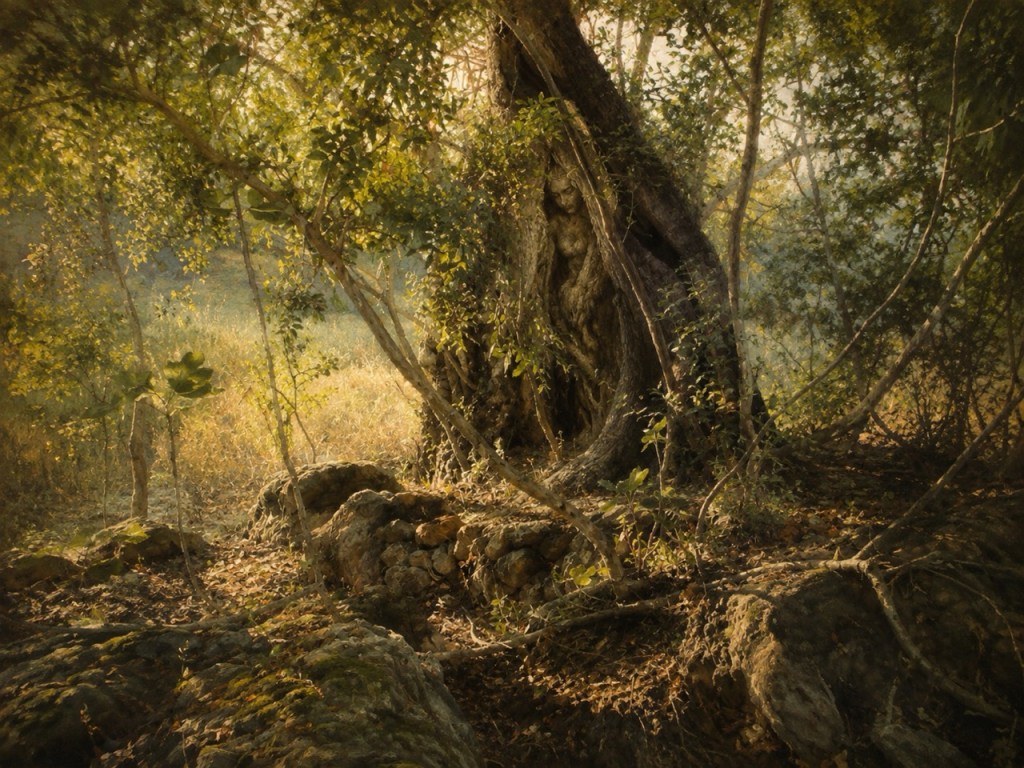
For landscape magic, this opens an important middle ground. When someone perceives a feminine presence in an ancient tree, or feels that a particular stone possesses a character of its own, we do not have to decide immediately whether that presence exists independently in the external world or is simply invented. There is a third possibility, closer to what Ohta’s data actually show: that the physical place and the imaginative capacity of the observer have entered into a transaction from which a genuinely new experiential form emerges — a form that can be studied carefully even while its ultimate ontological status remains open.
From picture to place
One of Ohta’s most useful distinctions concerns the way his participants alternated, sometimes within a single session, between regarding a landscape as an image and experiencing it as though they were actually standing within it. At times they treated the photograph frankly as an object — commenting on its composition, its balance of colour, whether it would look right on a wall at home. At other times they slipped, often without any prompting, into what Ohta calls a subject–object integrated condition, describing themselves walking through the forest, climbing the mountain, feeling the cold of the water on their skin. Following the aesthetician Arnold Berleant, Ohta notes that in this second mode participants no longer merely contemplated the landscape; they entered into it.
The distinction carried real consequences for how each landscape was judged. One participant explained that she could sense the true scale of the mountain scene when she took it as an actual place, but felt it shrink and flatten the moment she considered it “just a photograph,” bounded by its frame — and she rated the image accordingly lower as a photograph than she would have rated the place itself. Curiously, she felt no such gap when looking at the brook, because that particular scene had never promised the wide horizontal sweep a real mountain vista would offer, so nothing was lost in translation from place to picture. Another participant, asked about the sea, said she disliked the photograph and would never hang it in her home, precisely because being beside the actual sea let her lose herself pleasurably in loneliness, an experience she had no wish to invite into her living room. The same feeling, evoked by the same scene, was judged quite differently depending on whether it was being lived or merely displayed.
This distinction — landscape as object, observed from outside and available to measurement, description and analysis, against landscape as field, in which orientation becomes bodily, memory and imagination join sensation, and the visitor begins to feel located within the scene rather than positioned in front of it — may be foundational for our own project. Landscape magic, we would suggest, begins precisely at this transition. The place does not need to change physically at all. What changes is the mode of participation.
Entering the participatory field
Ohta’s own diagram of the “common structure” of landscape cognition places the encounter with a landscape at the top, feeding into memories and participants’ backgrounds, which in turn shape impression, imagination and association, aesthetic judgement, and the meaning and attractiveness ascribed to nature — all of which converge, together with comparisons drawn against earlier landscapes seen in the same session, into a final evaluation that keeps shifting as long as the encounter continues. Wave lines run beneath the whole structure in his diagram, marking the constant possibility of change at every level.
This gives a more exact description of what we have previously called entering a magical landscape. At first we arrive with names: tree, stone, path, hill, ruin, spring. Naming stabilises the world and allows orientation and practical action. As attention slows, other properties begin to emerge — temperature, direction, depth, enclosure, the movement of light, smell, bodily tension, silence, memory, attraction — until the place no longer appears as a collection of separate objects and begins instead to function as a field. We can now name at least five elements interacting within that field: the physical landscape itself, with its stone, vegetation, light, sound, temperature, orientation and scale; the embodied visitor, with posture, breathing, movement, autonomic state and sensory attention; environmental autobiography, carrying memory, previous landscapes and culturally acquired imagery; imaginal activity, with its associations, symbolic perceptions and spontaneous inner imagery; and time, because the landscape experienced after twenty minutes is demonstrably not the landscape experienced during the first thirty seconds. Ohta’s own data support exactly this dynamic view: his participants’ impressions, thoughts and emotions sometimes changed significantly over the course of a single session even though the photograph in front of them never changed at all.
Time as part of the method
This last element deserves particular emphasis, because it is the one most easily lost in conventional landscape research. Ohta pointedly criticises studies in which participants view a scene for as little as ten seconds before rating it on a predetermined scale — a procedure, common to studies from Calvin and colleagues in 1972 through to Herzog in 1989 and Patsfall and colleagues in 1995, that can capture little more than a first impression or a fragment of memory. His own participants spent, on average, more than ten minutes with each photograph, and Dearden’s observation from 1987 frames why this matters: when longer looking times are given to an observer, there is simply greater opportunity for more internal factors to interact with more of the landscape in question.
The consequences of that extra time show up directly in Ohta’s transcripts. One participant’s first response to the sunset photograph was sadness, tangled up with a memory of encountering beggar children under a red sky at dusk during a trip to Indonesia; but as the interview continued and her associations widened to include the sun’s raw energy, her mood shifted, and she arrived, unprompted, at a happier sense of future vitality within the very same image. Another participant, looking at the forest scene, reported that it had felt like early morning mist at first, but that as the minutes passed the mist seemed to her to be clearing, the light growing steadily brighter — even though nothing in the actual room, or the actual photograph, had changed at all. A third participant, who had insisted at the start of the interview that she had no real preferences among landscapes, discovered by the end of the sixth session that she plainly did, and said so with evident surprise at her own reaction.
For phenomenological fieldwork, the implication is immediate and practical. A place should not be judged too quickly. The first response is often dominated by orientation, expectation or simple visual novelty; after five minutes other sensory modalities tend to become more noticeable; after ten or fifteen, autobiographical material starts to surface, and the perceived character of the place can shift in ways the visitor did not anticipate and cannot always explain. Duration, in this sense, is not simply waiting for something to happen. It is one of the conditions through which the landscape becomes available in the first place, and a useful field note should record not only what was experienced, but when, in the unfolding of the encounter, it began to appear.
The landscape beyond vision
Ohta also found that landscape experience becomes multisensory almost immediately, even when participants are looking at nothing more than a still photograph. They imagined birdsong, the murmur of flowing water, the smell of trees, mist, grass and sea air, so readily that visual perception seemed to activate remembered touch, sound and smell almost as a matter of course. At an actual site, this multimodality is naturally far stronger. Landscape research has traditionally privileged vision — we look at views, photograph vistas, analyse composition — yet the lived landscape enters through the whole body: feet responding to slope and uneven stone, breath changing with the climb, shade altering temperature, wind reorganising sound, vegetation brushing against skin, smell carrying memory before conscious thought has identified its source. A phenomenology of landscape magic has to remain bodily for exactly this reason. The body is not simply transporting the mind through a site; it is one of the principal instruments through which the site becomes knowable at all.
Genius loci as transactional presence
Taken together, these findings allow us to sharpen our earlier use of genius loci. Ulrich’s influential 1983 model of landscape evaluation proposed that an initial, largely automatic affective reaction to an environment goes on to colour every subsequent cognitive response to it, treating the observer’s personal experience and history as comparatively marginal to that first affective jolt. Ohta’s interviews complicate this picture considerably: the connection between autobiographical memory and the human affective system turns out to be so strong, and so immediate, that the two are difficult to pull apart even analytically. Wilson’s idea of biophilia — a fundamental, partly innate human disposition to affiliate with living things, later broadened well beyond its original genetic framing by researchers such as Peter Kahn — offers one plausible foundation for why certain shapes and rhythms in the natural world (the curved, soft, endlessly varied lines that several of Ohta’s participants preferred to the sharp, straight, enclosing lines of the man-made world) continue to move us so reliably across such different individual histories.
Instead of imagining the spirit of a place as a fixed, invisible object hidden somewhere within the landscape, we can therefore explore the idea of a transactional genius loci. The place possesses real characteristics: a narrow ravine differs from an open plateau, a grove differs from a bare stone circle, an ancient tree differs from a concrete wall, and these differences genuinely shape what becomes possible in perception and action. Yet the experienced presence of a place arises through encounter, in the meeting of physical environment, body, memory, imagination and duration. This does not empty the concept of meaning; it gives it a phenomenological structure. The presence of a place may simply be what appears when those elements enter into a sufficiently coherent relationship with one another — weak in some landscapes, and in others extraordinarily strong.
A field method for entering the landscape
Ohta’s interview method suggests a more disciplined approach to our own fieldwork, built on Patton’s insight that open, largely unstructured questions allow a person to articulate experience before interpretation closes in on it. A simple sequence, adapted for future sessions in the landscape, might run as follows. First, let the visitor arrive without explanation. After several minutes, ask what they notice. Later, ask what kind of impression is forming, whether the place recalls anything, what they imagine beyond what is immediately visible, where their attention keeps returning, whether the place has changed since they arrived, and finally, whether anything emerged that they had not consciously intended to imagine. These questions deliberately avoid introducing ideas such as energy, spirits or sacredness in advance. They exist to let the participant’s own language surface first, so that interpretation, when it comes, comes afterward rather than in place of the experience itself.
What landscape magic may be
A phenomenological foundation of this kind does not remove the magical dimension from the landscape; it makes it possible to approach that dimension without premature certainty. A sustained encounter with a place can activate memory, alter attention, evoke imagery, reorganise affect and gradually weaken the ordinary distance between self and environment, until the landscape acquires something recognisable as a character of presence. Traditional cultures gave such moments the names of nymphs, tree spirits, enchanted women, guardians, ancestors or gods of place. We can remain genuinely agnostic about their ontological status while still taking the underlying experience seriously, on Ohta’s own terms: as something that happened, that can be described, and that changed as it was lived through.
The magical threshold, on this account, lies in the transition from observation to participation. The landscape ceases to be merely what is in front of us; we become involved in its appearing. Memory enters. Imagination enters. The body enters. Time enters. And from this interaction a field emerges whose qualities cannot be reduced completely either to the physical place or to the isolated psyche of the observer — the participatory field that gives this essay its title. To enter it is not to abandon reality. It is to discover that reality, as lived, has always included the relation between the world that appears and the consciousness through which it is encountered.
For the New Landscape Holistic Project, that relation is becoming the real territory of exploration. The task is no longer simply to find magical places. It is to learn how to enter a landscape deeply enough that its relationship with us can begin, in its own time, to reveal itself.


Pingback: New Landscape Holistic Project: The Magick Megalithic Circle Phenomenology | breath4balance