Movement, Thresholds and the Phenomenological Topography of Place
Over the course of the New Landscape Holistic Project, a different understanding of landscape has gradually begun to take shape. What first presented itself as a study of unusual places has become something more precise: an inquiry into the way landscape is lived through the body, memory, imagination and repeated presence. The previous parts of the series have brought us from the living tree to the participatory field, from embodied perception to dwelling. With M. Stuiber’s 1931 article Die siderischen Ströme. Die Wünschelrute, another possibility comes into view, although it only becomes useful once most of Stuiber’s own explanation is stripped away.
Stuiber’s article is written within an occult vocabulary that no longer serves us. He speaks of invisible sidereal currents, of underground matter producing different forms of radiation and of the dowsing rod as an instrument capable of detecting them. None of this needs to be retained. The theory is speculative and the rod itself is too vulnerable to ideomotor influence to function as evidence for hidden forces. Yet behind that apparatus lies an experimental intuition that is much more interesting. Stuiber assumes that a landscape is not homogeneous, that one may move through it and encounter differences from one place to another, and that these differences can be revisited, crossed again and approached from another direction.
Once the siderial currents and the rod disappear, what remains is a surprisingly contemporary question: can a landscape be read through movement?
The Landscape as a Differentiated Field
A landscape is never experientially uniform. We know this immediately when we walk through a complex environment. A path passes from shade into sunlight, from soft soil onto rock, from enclosure into openness. The body registers these transitions continuously. Breathing changes with inclination, muscular tension changes with footing, peripheral vision changes with vegetation, and sound alters as space opens or closes.
Some changes are obvious. Others are not.
There are moments when a place simply begins to feel different before we have any clear idea why. The body slows down. Attention narrows. We become unusually alert. A location seems to invite stopping, while another encourages movement. Sometimes a particular area repeatedly attracts the gaze without there being an immediately apparent object responsible for it.
Traditional occultism was inclined to explain such differences by positing invisible forces. A contemporary phenomenology can remain closer to the experience itself. The important observation is not that a hidden current has been discovered, but that a change in embodied experience has occurred at a particular location.
That shift is enough to open a field of inquiry.
Movement as a Method
Much landscape research begins from a stationary observer. A view is framed, photographed, mapped and described. Even when we walk through a landscape, we often continue to treat it as scenery.
Stuiber’s procedure, despite its speculative interpretation, contains a different logic. The observer has to move. A supposed reaction is encountered while crossing a location, after which the person returns to the same area and approaches it again. The emphasis lies less on what the site looks like than on what happens in the relation between body and place during movement.
This suggests a useful modern practice. One can walk slowly across a landscape without searching for anything in particular and simply observe where the quality of experience changes. The route itself becomes the experiment.
A place approached uphill may not be the same place when approached downhill. A narrow opening encountered from an open plateau is phenomenologically different from the same opening encountered while leaving a dense grove. Direction, effort, anticipation and visibility all participate in the way a location appears.
Landscape therefore cannot be understood entirely from a map. It is disclosed through trajectories.
The Body Before the Explanation
Here the work of Seamon and Macpherson becomes especially relevant. The body is constantly registering information that does not immediately enter reflective awareness. Posture, balance, kinaesthesia, sound, temperature, visual periphery and muscular effort contribute to our sense of place long before we consciously formulate what is happening.
The old dowser’s rod can therefore be understood in another way. It may not reveal an invisible radiation at all. It may simply amplify a minute bodily movement produced by expectation, perception or association. From the standpoint of occult proof, this is a serious problem. From the standpoint of embodied phenomenology, however, it raises a more interesting question: what was the body responding to?
The answer may be simple. A subtle incline. A change in ground texture. A difference in humidity. A shift in sound. A narrowing of visual space. It may also involve memory or unconscious recognition. The nervous system can register complex configurations without being able to name them.
This is why the first description should remain modest.
Something changed here.
The temptation to explain the change should come later.
Phenomenological Thresholds
The idea of a threshold offers a useful way of describing these moments. A threshold need not be a doorway or an obvious boundary. It may be a point where the experienced quality of the landscape shifts.
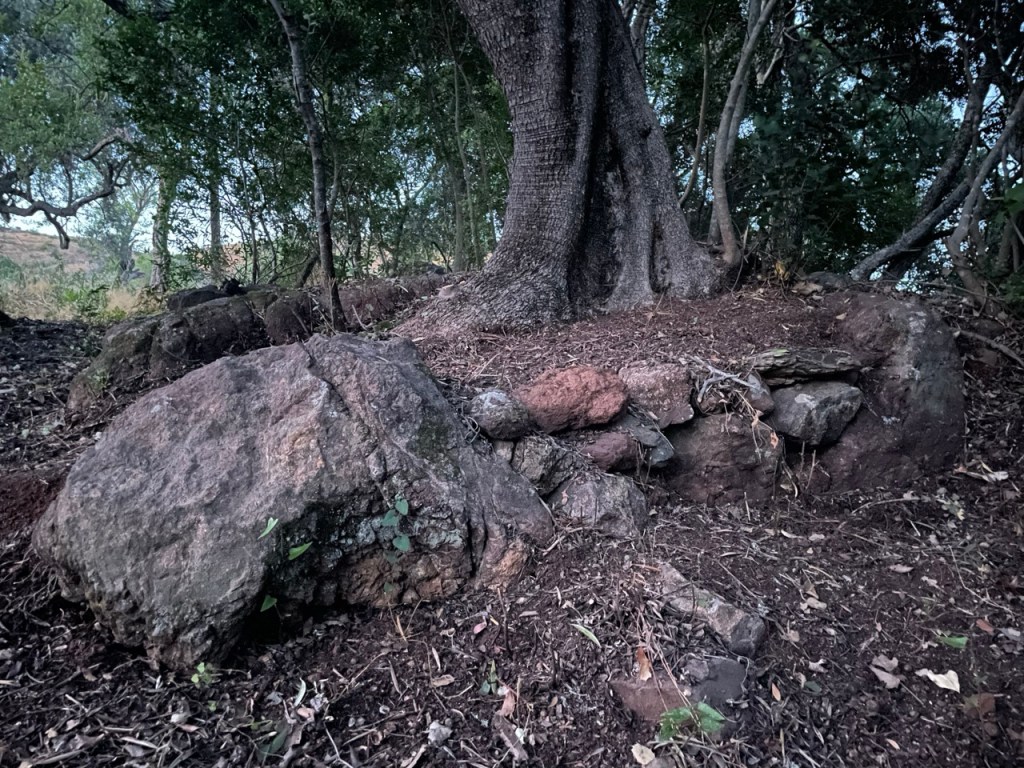
One steps beneath a canopy and the space contracts. One reaches a ridge and the horizon suddenly expands. These are clear thresholds. Yet subtler ones may also exist. A particular cluster of stones may repeatedly change the pace of walking. A place beneath an old tree may produce a consistent sense of stillness. A narrow section of terrain may create unease without an obvious reason.
These experiences become especially interesting when they recur.
A single sensation may be accidental. A repeated change at roughly the same location begins to suggest an internal structure in the landscape as lived.
This gives us a more precise way of thinking about genius loci. The character of a place need not be distributed evenly across an entire site. A landscape may have its own phenomenological topography, with areas of concentration, release, enclosure, orientation and transition.
The genius loci may therefore be encountered not only as the atmosphere of a whole site, but through the differences within it.
Phenomenological Transecting
A simple field method follows from this.
A participant enters a landscape without being told that any particular part of it is important. A route is chosen and walked slowly. There is no search for energy, sacredness or signs. The task is only to notice whether the quality of experience changes.
When a noticeable shift occurs, the location is remembered or recorded discreetly. The participant continues walking and completes the route before attempting interpretation.
Later, the same route can be walked in reverse. On another day it can be repeated again. A second participant can follow the same path without knowing where previous changes were reported.
Only afterwards are the observations compared.
If the experiences do not correspond, that result matters. If several encounters cluster around the same location, that becomes equally interesting.
The important point is that no metaphysical claim is required. One can simply say that a certain place repeatedly coincided with a change in embodied experience.
That is already a meaningful finding.
Mapping Without Reducing the Landscape
There is a danger in turning such observations into maps. The moment an experience is reduced to a dot on paper, the richness of movement, duration, sound, temperature and bodily effort can disappear.
The map therefore has to remain secondary.
It should function as an aid to memory rather than as a representation of the landscape itself. A marked location should ideally be accompanied by a description of what happened there. The body slowed. The breath deepened. The field of vision widened. There was an impulse to turn around. An image appeared. A feeling of enclosure suddenly emerged.
The point on the map does not explain the event. It merely preserves its location.
Over time, several such maps may begin to reveal patterns. Those patterns are questions rather than answers.
The Role of Expectation
Any serious investigation of this kind has to take expectation into account. Our earlier work on imagination has already shown how strongly anticipation can shape experience.
If a participant is told that a certain tree stands on a powerful spot, an unusual experience near that tree is difficult to interpret. The expectation has already entered the field.
The more interesting procedure is to keep the supposed points unknown. If several people independently register changes in roughly the same area, the place becomes worthy of further attention. Even then, many explanations remain possible. The effect may arise from terrain, sound, vegetation, temperature, visual structure or some combination that nobody consciously noticed.
The strength of the method lies precisely in refusing to decide too quickly.
Phenomenology can remain open without becoming credulous.
A Landscape of Invitations
Gibson’s idea of affordances, which entered our project in the previous part, becomes more subtle here. A landscape offers possibilities for action. A stone affords sitting, a path affords walking, a branch affords grasping. Yet there may also be quieter forms of invitation.
A place may invite stillness.
Another may draw the body forward.
A particular opening may encourage looking back.
A tree may repeatedly attract proximity.
These invitations need not be messages in any literal sense. They can be understood as relational structures emerging between the capacities of the body and the configuration of the environment.
This is where landscape magick begins to acquire a new meaning. It becomes less concerned with detecting hidden forces and more concerned with cultivating sensitivity to the way place and organism meet.
From Magical Geography to Phenomenological Topography
Stuiber believed that his rod disclosed an invisible structure beneath the landscape. We can retain the idea of hidden structure while changing what we mean by hidden.
A landscape contains far more information than conscious perception can hold at once. Its geometry, materiality, vegetation, acoustics, temperature and light continuously interact with a body that is itself shaped by memory, expectation and previous experience. Much of this interaction remains beneath the level of explicit thought.
The hidden structure may therefore be the structure of the relation itself.
What becomes visible through careful walking is not necessarily an occult current, but a pattern in the way experience changes across space.
This suggests the possibility of a phenomenological topography of place, a map that does not begin with physical elevation or geological layers but with recurrent changes in lived experience.
Such a topography would remain provisional. It would alter with season, weather, bodily condition and personal history. Yet precisely because these variables can be recorded, the method becomes richer rather than weaker.
The Sensitive Landscape
Across the previous parts of this series, the landscape has gradually become less object-like.
The tree became a living counterpart.
Memory and imagination revealed a participatory field.
Embodiment showed that landscape is known through movement and sensation.
Dwelling introduced repeated presence and familiarity.
What Stuiber unexpectedly adds is the possibility that the participatory field is internally differentiated.
Not every part of a place needs to affect us in the same way.
This is what I would call the sensitive landscape. The term does not imply that the land itself possesses a mysterious sensory faculty, nor that the observer is merely projecting meaning onto inert matter. Sensitivity belongs to the relation between the two.
The landscape offers gradients, structures and possibilities. The body responds with perception, movement, memory and imagination. What emerges is a field in which certain places may repeatedly become more salient than others.
Reading the Landscape with the Body
The direction of the project is becoming clearer.
Landscape magick no longer needs to begin with the claim that unusual places contain invisible energies. It can begin with something much more immediate: the human capacity to enter a place attentively enough for its internal differences to become perceptible.
We walk.
We notice.
We return.
We approach from another direction.
We compare.
We allow experience to accumulate before explanation closes around it.
This does not remove the numinous dimension. A landscape may still become sacred. An unexpected image may still arise. Presence may still appear. A place may acquire the quality of encounter.
The difference is methodological. We no longer need to decide beforehand what such experiences mean.
Perhaps the most useful thing that can be recovered from Stuiber’s obscure experiment is therefore not the dowsing rod at all. It is the intuition that a landscape becomes legible in another way when the body is allowed to participate fully in the act of reading.
The land does not need to send an invisible signal.
It is enough to notice where our relation with it changes, and then to return carefully enough to discover whether it changes there again.
Source
M. Stuiber, “Die siderischen Ströme. Die Wünschelrute,” Zentralblatt für Okkultismus, 25th year, 1931/32, pp. 14–18.


Pingback: New Landscape Holistic Project: The Magick Megalithic Circle Phenomenology: the Complete Serie Index | breath4balance