A Practical Guide to Place, Perception and the Imaginal World
Landscape Magick explores how a place can become more than scenery. It can become a field of attention, relationship, symbolism and encounter.
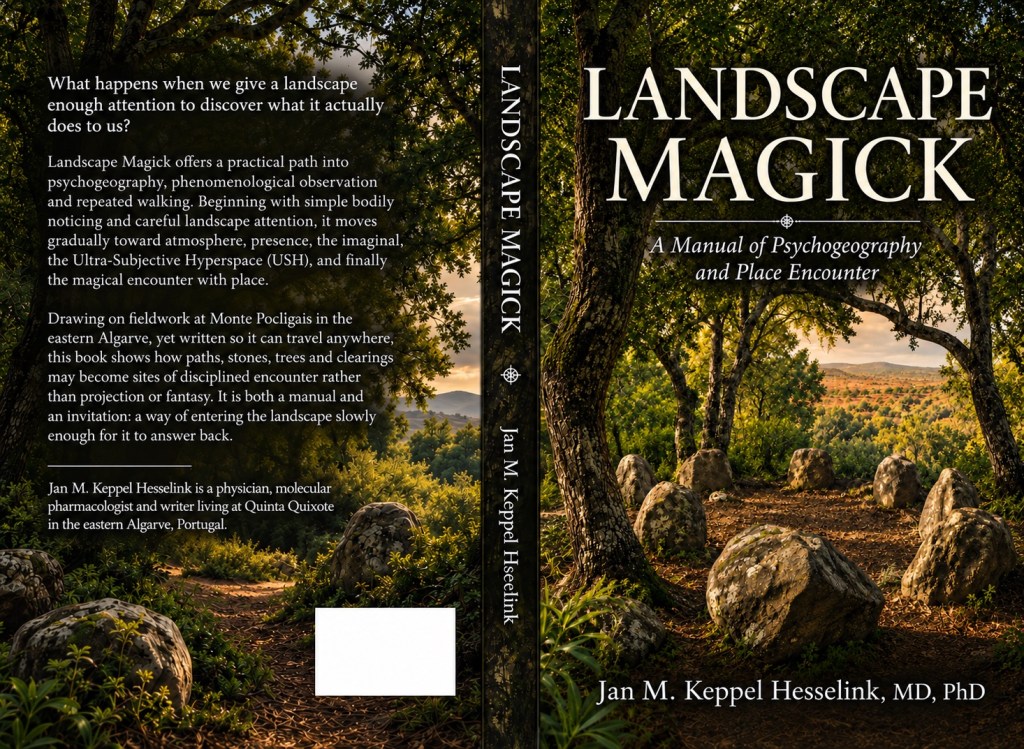
This book develops a practical method for working with landscape through observation, movement, imagination, ritual and first-person inquiry.
It brings together psychogeography, phenomenology, animism, contemplative practice and traditional magical techniques in a form that can be tested directly in the field.
Order the Book
The book is available internationally. Choose your region or preferred bookseller below:
ORDER IN NEDERLAND
ORDER IN CANADA
ORDER IN SPAIN
ORDER IN FRANCE
ORDER IN GERMANY
ORDER IN CHINA 中国读者可通过国际渠道订购
ORDER IN INDIA
When a Place Begins to Answer Back
Most of us move through landscapes quickly.
We identify a hill, a path, a tree, a ruin, a stream. We give things names and continue walking.
But sometimes something different happens.
A particular stone attracts attention repeatedly. A clearing feels strangely charged. The body relaxes at one point and becomes alert at another. A path seems to invite movement in one direction. An image, memory or figure appears unexpectedly.
Landscape Magick begins with these moments.
Rather than deciding immediately what they mean, the book asks a more useful question:
What happens when we learn to attend to them systematically?
From Observation to Relationship
The method begins with careful perception.
How does the body respond to a place? Does breathing change? Does walking slow down? Does attention repeatedly move toward one feature of the landscape? Does the same response return on another day?
From there, the work gradually develops.
A place may begin to function as a counterpart rather than as a passive background. Symbolic associations arise. Imaginal figures may appear. Certain locations develop a recognizable character. Ritual and simple magical acts can then be introduced deliberately rather than superimposed from the beginning.
The result is a form of practice in which landscape becomes both laboratory and participant.
Psychogeography Meets Magick
Landscape Magick draws from several traditions that are rarely brought together.
Psychogeography asks how environments shape movement, mood and perception.
Phenomenology asks us to describe experience before explaining it.
Animist traditions explore relationships with other-than-human presences.
Western magical practice contributes symbolic action, sigils, elemental correspondences and ritual structure.
Contemplative traditions contribute sustained attention and the capacity to observe inner experience without immediately becoming absorbed in it.
The book combines these strands into a practical field method.
The Landscape as an Inner Laboratory
One of the central themes of the book is that outer landscape and inner experience cannot always be separated cleanly.
A place affects the observer, but the observer also brings memory, expectation, imagination and symbolic structure into the place.
This is precisely why disciplined observation matters.
Landscape Magick therefore treats experience neither as proof of an invisible world nor as something to be dismissed as mere projection.
Instead, the reader learns to work with what appears.
What returns?
What changes?
What remains stable over time?
What happens when the same place is approached differently?
What happens when another person enters the same landscape without being told what to expect?
These questions transform unusual experiences into something that can be explored rather than merely believed.
Elementals, Sigils and Imaginal Figures
As the work deepens, the book introduces more explicitly magical methods.
Elemental symbolism can be used to organize qualities of place.
Sigils can act as intentional markers or interfaces.
Imaginal figures can be approached as structured presences within consciousness, without forcing an immediate answer to the question of whether they are internal, external, or something in between.
The emphasis remains practical.
How does one prepare attention?
How does one allow imagery to arise without simply inventing it?
How can an encounter be recorded and compared over time?
How does one distinguish repetition from suggestion?
This is where landscape magick becomes a disciplined practice rather than fantasy.
A Method Developed in the Algarve
Much of the work described in the book emerged through repeated exploration of a particular landscape in the hills of the eastern Algarve in Portugal.
Stone, oak, water, abandoned structures, paths, slopes and clearings gradually revealed a complex experiential geography.
The book uses this landscape as a case study, but the method is not tied to one place.
It can be applied in Wales, Vermont, India, the Alps, a city park, an abandoned industrial site, or a patch of woodland near home.
What matters is not the exotic quality of the landscape.
What matters is the quality of attention brought to it.
Who This Book Is For
Landscape Magick is written for readers interested in:
psychogeography, contemplative practice, animism, ritual, sacred landscape, imagination, esotericism, consciousness studies and first-person exploration.
No previous magical training is required.
The book can be read as a practical manual, a philosophical investigation, or as an invitation to begin observing landscape in an entirely different way.
Why Landscape Magick Now?
Modern life increasingly places us inside screens, vehicles, buildings and informational environments.
Landscape becomes something we pass through rather than something we inhabit.
This book proposes another possibility.
To walk slowly enough to notice.
To remain in one place long enough for patterns to appear.
To allow the boundary between observation and participation to become more interesting.
And to discover whether the world becomes different when we learn how to encounter it differently.
About the Author
Prof. Dr. Jan M. Keppel Hesselink, MD, MSc, PhD is a physician, neuroscientist, professor emeritus of molecular pharmacology, meditation teacher and long-term practitioner of contemplative traditions.
His work explores the borderlands between consciousness, imagination, ritual, medicine and first-person experience.
Landscape Magick grew out of years of fieldwork, contemplative practice and repeated observation of how particular places can begin to acquire structure, meaning and presence.
Breath4Balance
Breath4Balance explores the meeting point between contemplative traditions, psychology, neuroscience, altered states of consciousness and first-person investigation.
Landscape Magick extends that work outward.
The laboratory is no longer only inside the mind.
It is also the path, the stone, the tree, the water, and the place where attention meets the world.

