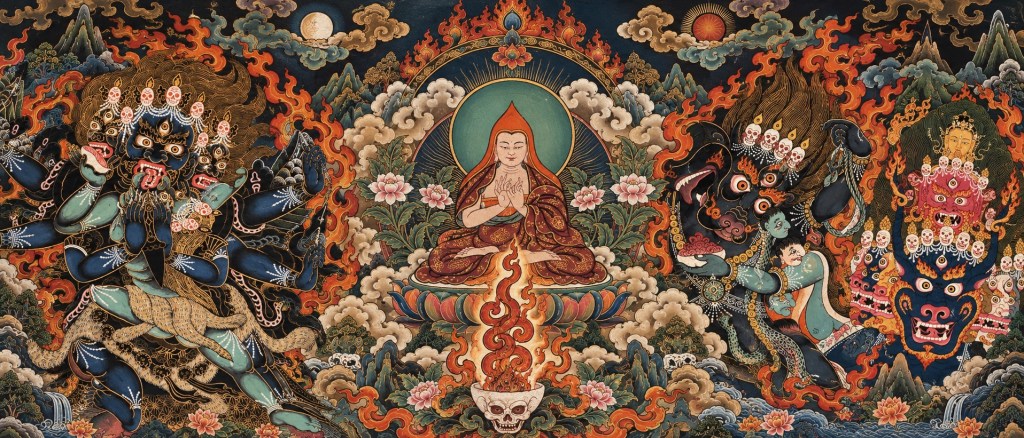
Since the 1970s, I have travelled extensively through Nepal, Bhutan and India, where I met and studied with many spiritual teachers. One subject that has fascinated me throughout those decades is the extraordinary visual world of Tibetan thangkas. I have always been struck by their power, complexity and precision.
After many years of study, I came to see these works not simply as sacred paintings, but as highly structured visual instruments that encode layers of symbolic, contemplative and esoteric knowledge. In this book, I try to disclose something of that deeper dimension: the inner logic and esoteric essence of these remarkable works of art.
Order the Book
The book is available internationally. Choose your region or preferred bookseller below:
Tibetan and Nepalese thangkas are among the most intricate visual creations in the history of contemplative culture. At first sight they may appear to be devotional paintings, filled with Buddhas, bodhisattvas, protective figures, symbols, flames, clouds, animals and geometric structures. But a thangka is more than an image to be looked at. It is also a map!
A traditional thangka can function as an aid to meditation, visualization, ritual and inner orientation. Every gesture, colour, attribute and spatial relationship has meaning. The image does not simply represent a sacred world. It provides a carefully structured visual environment through which attention can move.
This book explores that world.
A Visual Journey into Tibetan Sacred Art
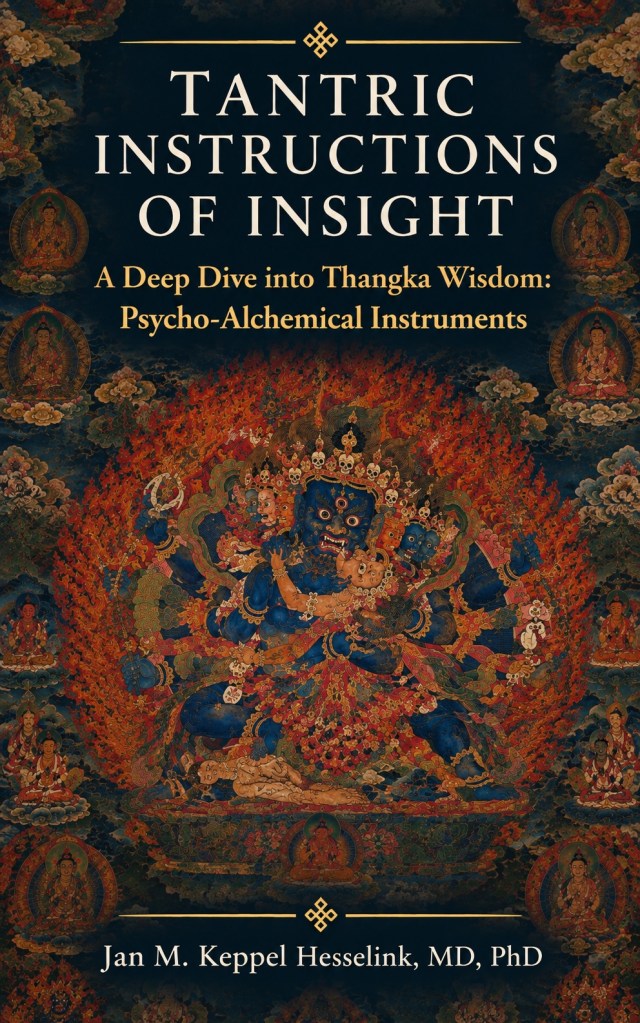
The book brings together a carefully selected collection of thangkas and places them in their historical, symbolic and contemplative context.
Rather than treating the paintings only as art objects, we approach them as working images. What happens when the eye rests on a figure repeatedly? Why are certain deities peaceful while others appear terrifying? What is the function of the mandala? Why are some figures surrounded by fire? What do the colours, implements, animals and postures communicate?
The further one enters into this visual language, the clearer it becomes that almost nothing in a traditional thangka is accidental.
The paintings offer a remarkable interface between image, attention, imagination and contemplative practice.
Images That Were Made to Be Used
In the West, sacred art often ends up on museum walls. Traditionally, thangkas belonged to a very different context. They were rolled and transported, displayed during rituals, used in teaching and contemplated during meditation.
For practitioners, the image could become part of an inner exercise. A figure first encountered externally might gradually be reconstructed in imagination until its details could be held with increasing precision.
Seen in this way, the thangka becomes particularly interesting for the work we explore at Breath4Balance and in the Inner Laboratory. It stands at the border between perception and imagination, between an external image and an internally generated one.
The painting becomes a doorway into the imaginal field.
What You Will Find in the Book
The book combines high-quality images with accessible commentary on the history, symbolism and function of Tibetan thangkas.
Readers are introduced to the visual grammar of the paintings, the principal types of figures, recurring symbols and ritual objects, the architecture of mandalas, and the contemplative practices in which these images traditionally played a role.
No previous knowledge of Tibetan Buddhism is required.
The book can be approached as an introduction to sacred art, as a visual exploration of Buddhist symbolism, or as a study of one of the most sophisticated systems ever developed for working with attention and inner imagery.
Why We Made This Book
Our interest in thangkas goes beyond their extraordinary beauty.
For centuries, contemplative traditions have investigated how attention can be trained and how mental imagery can be stabilized, transformed and explored. Thangkas preserve one highly developed expression of that knowledge.
They remind us that an image can be more than an illustration.
It can become an instrument of consciousness.
If you are arriving here after watching one of our films, welcome. This page will always contain the most up-to-date links for ordering the book worldwide. This is not simply a book about thangka art. It explores how these images function as instruments of attention, visualization and inner transformation.
About Breath4Balance
Breath4Balance explores the meeting point between contemplative traditions, neuroscience, psychology and first-person investigation.
Our work includes meditation, altered states of consciousness, imagery, attention training and the historical techniques through which human beings have attempted to explore the inner world.
The thangka belongs naturally within that investigation.
It is at once art, symbol, meditation object and map of consciousness.

